Gas Mixer for Gas Chromatograph Calibration - Sotacarbo

GAS CHROMATOGRAPH
METHANOL & DME PRODUCTION
CATALYST SYNTHESIS
TARGET OF THE PROJECT
Gas Chromatograph Calibration - Methanol and DME production from CO2: catalyst synthesis, characterization and performance.
Description of the Application.
Increasing attention toward climate change and the recent strategic policies to stabilize and reduce the amount of CO2 emissions have resulted in the promotion of research in the field of carbon capture, utilization, and storage, where CO2 utilization technologies are expected to play a very important role.
The aim of the activity is the development of advanced catalysts, both supported and non-supported for the production of methanol and dimethyl ether (DME) from CO2. Thanks to the encouraging results, the obtained catalysts are the subject of the PCT (Patent Cooperation Treaty) application number PCT/EP2019/053068: “Efficient catalyst for the conversion of CO2 to methanol”.
Their catalytic activity is determined in a high-pressure automatic bench-scale reactor under realistic conditions (250°C, 30 bar, gas feed: 75% H2/25% CO2, by volume).
The concentrations of the inlet gas and the reactor effluent are monitored by means of an online gas chromatograph (Agilent 7890B) equipped with a TCD detector for H2, N2, CO2, CO, and the possible hydrocarbons (CH4, C3H8, C4H10, etc.) and an FID detector for H2S, CO2, CH3OH, DME, C4/C5.
Benefits and Savings.
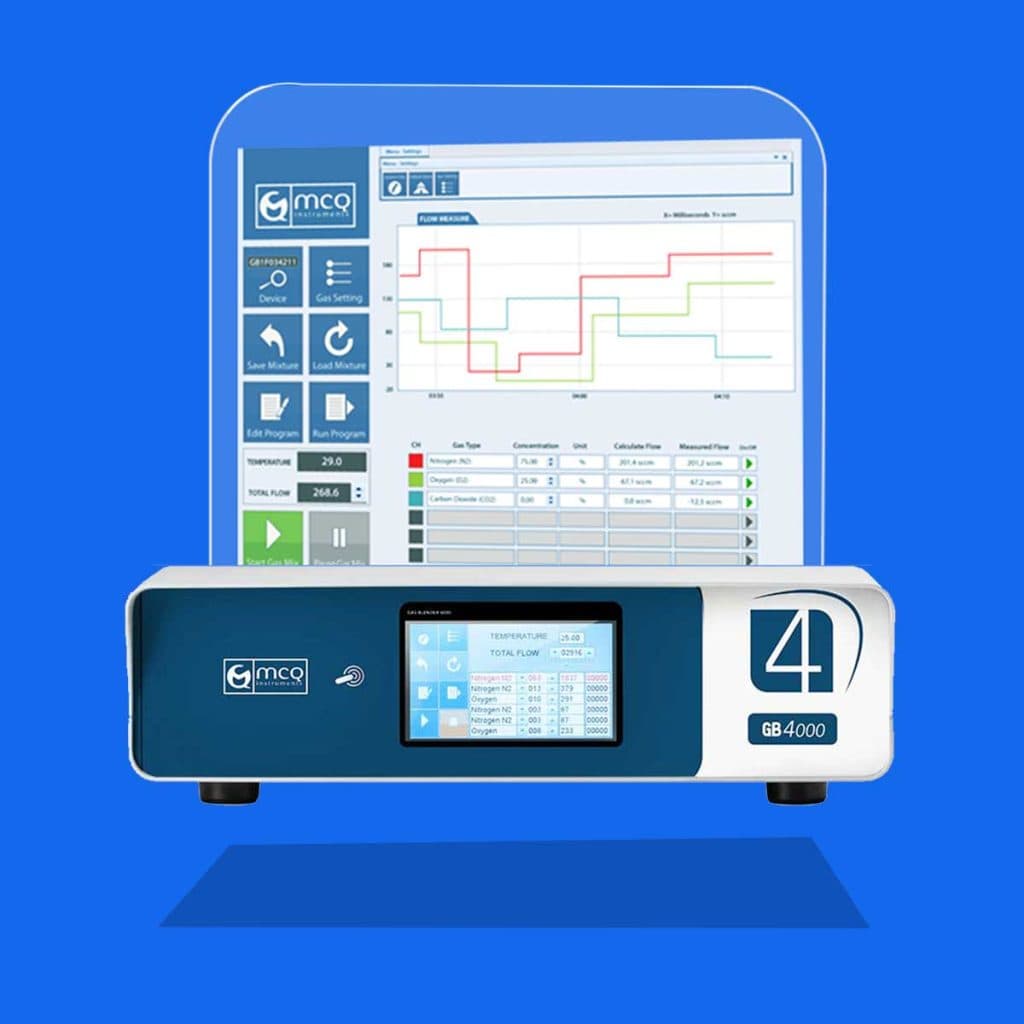
The use of the MCQ 4000 series allows to obtain a double advantage: (i) the desired concentration of different gas mixtures for the achievement of reliable calibration curves using only pure gases; (ii) the possibility to feed, at low pressure, the bench-scale plant with different gas compositions and different concentrations, including a simulating syngas.
A traditional calibration method would require as many gas cylinders, at different concentrations, as the number of points in the calibration curve. Furthermore, dimethyl ether (DME) is hard to be obtained in different concentrations, and it is often mixed with other impurities and it is unstable. Besides, a lot of time is required for gas delivery.
In this regard, with MCQ instruments, Sotacarbo needs only of a pure gas cylinder of DME, mixed with an inert gas (N2) for calibrating the GC instruments.
This solution has been successfully employed for calibrating other gases such as H2, CO2, CO, CH4, or N2 with a remarkable saving of money and reduced time.
ABOUT SOTACARBO
Sotacarbo - Società Tecnologie Avanzate Low Carbon S.p.A. - was established on April 2nd 1987, the main aim was to exploit coal through the development of advanced clean coal technologies. The most important tool to reach this goal was the construction of the Sotacarbo Research Centre, which included the design and construction of pilot and demonstration plants; the development of studies and experimentations on new technologies; the design of new industrial plants for coal use. The current shareholders are ENEA (The Italian national agency for new technologies, energy and sustainable economic development) and the Sardinian Regional Administration.
Ref: Sotacarbo WebsiteMAIN BENEFITS
- •GAS MIXER VS. MASS FLOW CONTROLLER. GB4000 Series and its software made the calibration an easy procedure comparing it with the traditional mass flow controllers system.
- •WITHOUT MCQ INSTRUMENTS? A standard calibration method using gas cylinders containing a mixture of gases at the desired concentration would have been used for the GC setting. The use of standard Mass Flow Controller in order to feed the bench scale plant is required to TIME SAVINGS: create the desired mixture.
- •TIME SAVING. Without the MCQ Gas Blender, for each point of the calibration curve, the replacement of the gas cylinder is necessary. With the MCQ solution you can quickly calibrate the instrument for several types of gases without any replacement.
- •SOFTWARE AUTOMATION. Thanks to our Software PRO version and its option “Automatic Program”, now Sotacarbo can bring forward experiments in automation, painlessly.
- •MICRO-FLOW. NO CUT-OFF. MCQ GB4000 Series allows you to control the flow in all the calibration range, from 1 ml/min to 5000 ml/min with NO cut-off.
- •FLOW STABILITY. Thanks to our revolutionary method every gas flow has a great stability making possible to have a stable flow also for a lower flow-range.