Gas Mixer for Gas Dilution - Polysense - Politecnico di Bari

GAS DILUTION
MICRO FLOW
H2S DETECTION IN THZ RANGE
TARGET OF THE PROJECT
Dilution of H2S for detection in THz range
Description of the Application.
Gas sensing spectroscopic techniques aim to operate with isolated or well-separated absorption lines characterized by large cross-sections.
The THz spectral range offers many advantages for gas spectroscopy because of the comb-like distribution of the spectral features, the strongest line strengths in the whole infrared region, and the fastest relaxation rates.
Hydrogen sulfide (H2S) shows absorption bands in the THz region up to two orders of magnitude stronger with respect to the mid-IR range and the possibility to be detected avoiding the interference of hydrocarbons.
The application developed is based on a liquid nitrogen-cooled THz QEPAS sensor, employing a pulsed QCL to excite an H2S rotational transition at 95.63 cm-1.
Benefits and Savings.
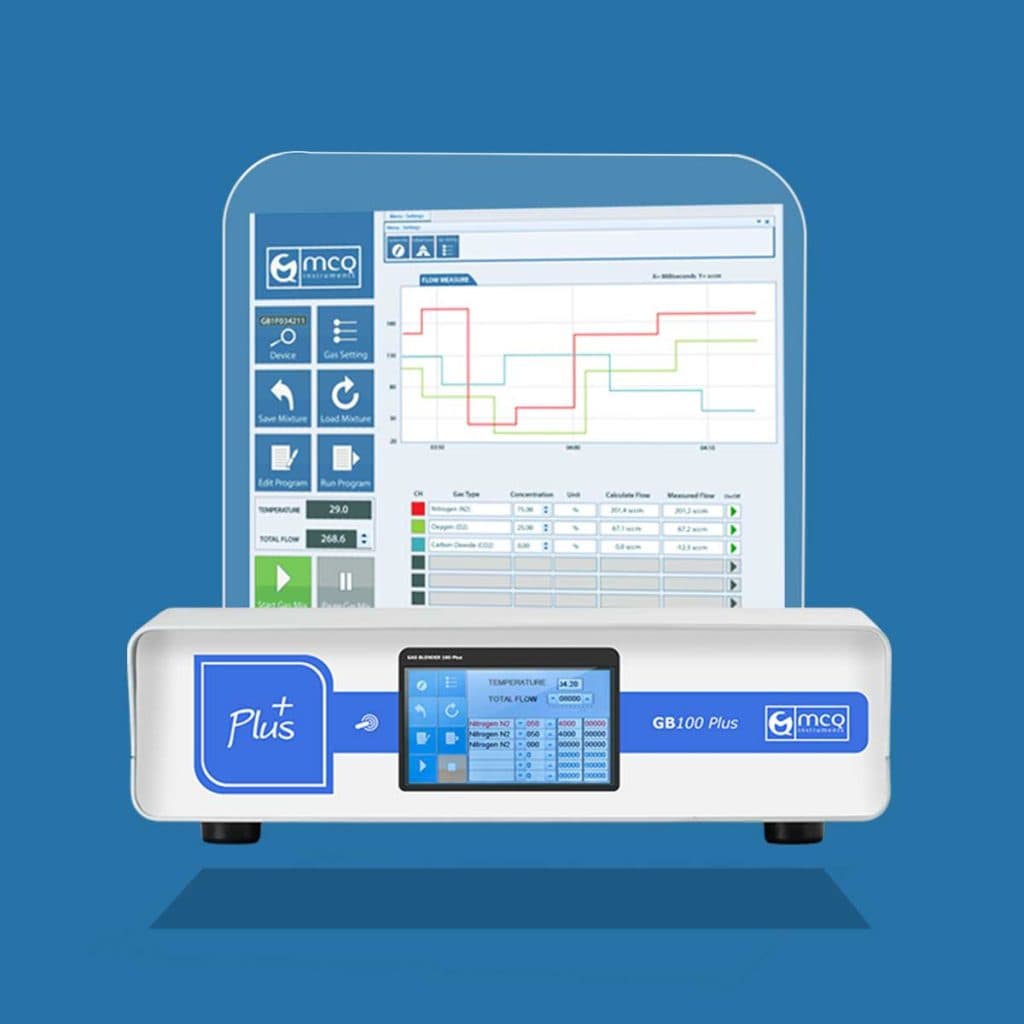
The Gas blender 100 was used to dilute a certified gas mixture of 200 ppm of H2S in pure N2 down to 20 ppm. The mixtures generated led to a linear response from the QEPAS sensor, confirming that the maximum concentration of 200 ppm was not damaging the device. The calibration of the QEPAS sensor allowed us to calculate a minimum detection limit in the part-per-billion concentration scale. This prototype sets the basis for highly challenging and ambitious tasks such as H2S detection in natural gas.
READ THE SCIENTIFIC PAPERS.
Journal: ELSEVIERTitle: Quartz-enhanced photoacoustic spectroscopy for hydrocarbon trace gas detection and petroleum exploration.Journal: SPIE Digital LibraryTitle: Fiber-coupled quartz-enhanced photoacoustic sensor for methane and ethane trace detection.Journal: SPIE Digital LibraryTitle: N2-cooled THz quartz-enhanced photoacoustic sensor operating in pulsed mode for hydrogen sulfide detection in the part-per-billion concentration rangeJournal: APPLIED SCIENCESTitle: Quartz-Enhanced Photoacoustic Detection of Ethane in the Near-IR Exploiting a Highly Performant SpectrophoneABOUT THE UNIVERSITY
The Polytechnic University of Bari (Italian: Politecnico di Bari) is a university located in Bari, Italy. It was founded in 1990 and it is organized in 3 Faculties. In 2016, around 9752 students were enrolled. In 2013, the professors, researchers and assistants amounted to 302 people. The Polytechnic University of Bari is the youngest among the Italian polytechnic universities. Even though other Italian universities also incorporate engineering and science faculties, Italian polytechnic universities are focused on technological faculties and subjects.
Ref: WikipediaMAIN BENEFITS
- •GAS MIXER VS MASS FLOW CONTROLLERS. The GAS MIXER channels it’s more compact than typical flow controller meters and can be specifically calibrated on the mixture to be used.
- •WITHOUT MCQ INSTRUMENTS? Since the laboratory was not equipped at all with instrumentation devoted to spectroscopy. The portability of the GB100 allowed Polysense to perform the calibration.
- •TIME SAVINGS. Instead of changing a calibration cylinder for each point, our Gas Mixer uses pure gas allowing the Politecnico di Bari to set all the desired calibration points in just a few steps.
- •SOFTWARE AUTOMATION. Thanks to our Software PRO version and its option “Automatic Program”, now Politecnico di Bari can bring forward experiments in automation, painlessly.
- •MICRO FLOWS. NO CUT-OFF. OUR GB100 Series allows you to control the flow in all the calibration range, from 0,1 ml/min to 500 ml/min with NO cut-off.
- •HIGH DILUTION RATIO. We helped the Politecnico di Bari to dilute a certified gas mixture of 200 ppm of H2S in pure N2 down to 20 ppm to get highly precise and stable micro-flows of gas to fed a spectometer.