Gas Mixer for Photoacoustic sensing for air quality monitoring - CNR / INO

SENSOR CALIBRATION
AIR QUALITY MONITORING
HIGH PRECISION
TARGET OF THE PROJECT
Developing a sensor able to detect sensitivity below the part-per-billion range on selected chemicals
Description of the Application.
CNR-INO is developing and testing a photoacoustic trace-gas sensor. The sensor is based on the photoacoustic technique, where a gaseous sample is periodically excited with a modulated laser. The excitation and the subsequent non-radiative de-excitation of the excited molecules produce an acoustic wave in the gaseous sample, which is proportional to the target gas concentration.
CNR-INO uses a MEMS cantilever acting as acoustic transducers and a balanced interferometer to transform the acoustic wave into a measurable signal. The sensor is aimed at achieving a detection sensitivity below the part-per-billion range on selected chemicals. It will be used for environmental monitoring, safety and security on ongoing projects. At present, the sensor is under development, with ongoing characterization activities.
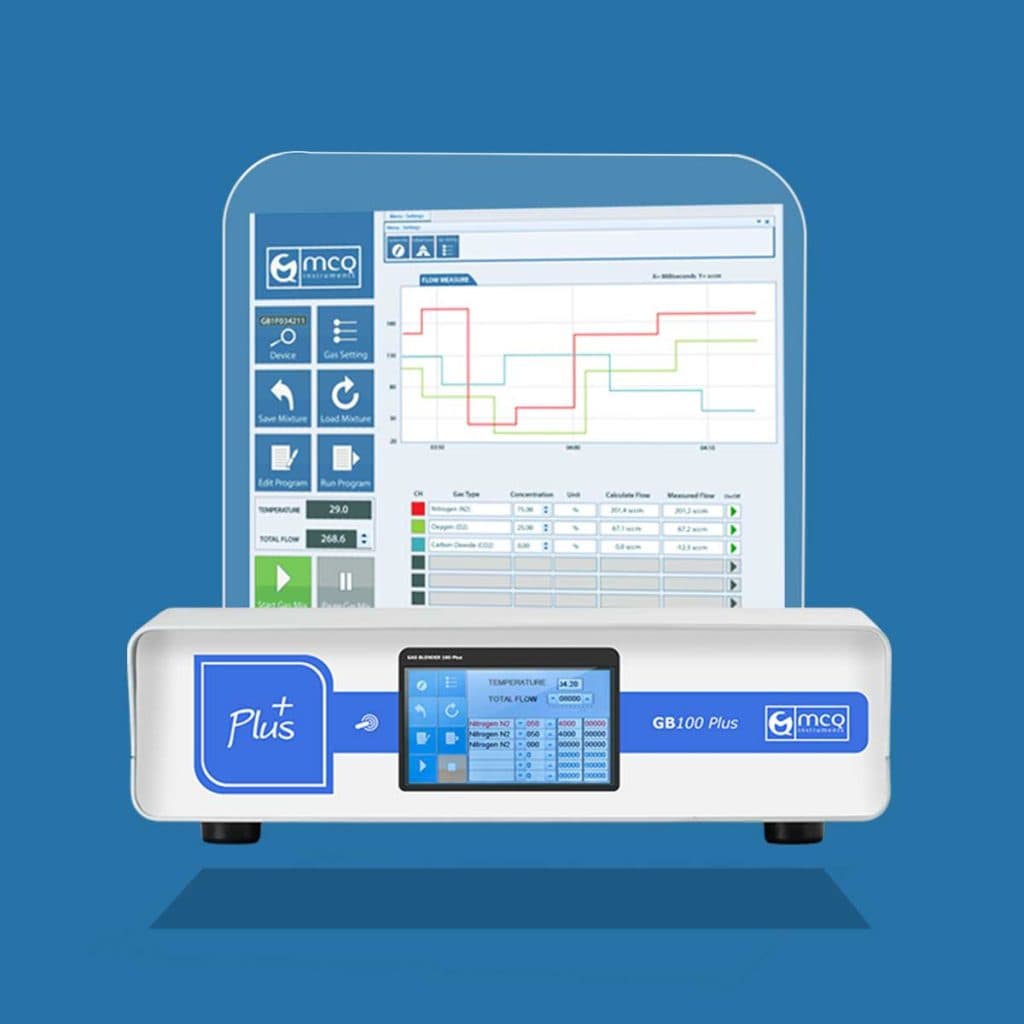
For determining the ultimate sensitivity and for validating the sensor, we are using N2O and CO in N2 as target samples. For this tests we need to prepare different samples with various gas concentrations, by mixing gases from certified bottles. The MCQ instrument’s Gas Blender is used to mix different gaseous samples from certified bottles, in order to achieve the desired gas mixture and the desired pressure.
Benefits and Savings.
Instead of using simple valves for mixing the different gaseous samples, with rough precision, the MCQ Instruments Gas Mixer provided higher precision in the gas mixture, repeatability and speed.
ABOUT THE PROJECT
The National Institute of Optics (Istituto Nazionale di Ottica, CNR-INO) has been working for over ninety years in the broad field of Optics, updating its activities in line with the huge innovations that have characterized this area over the last century. Its main activities include pure and applied research, technology transfer, and training. These are accompanied by metrology, consulting, and testing services for both public institutions and private companies.
Ref: CNR INO WebsiteMAIN BENEFITS
- •Cost and Space Savings. COST AND SPACE SAVINGS. Our Gas Mixers offer a simple solution. Say goodbye to expensive, challenging-to-store, slow-to-deliver pre-mixed cylinders. With our easy-to-use gas mixers and software, create your perfect gas mixtures effortlessly. Just grab a pure gas cylinder, click a few buttons, and voila! Custom gas mixtures tailored to your needs at any time, hassle-free.
- •SUCCESSFUL ACHIEVEMENT. The MCQ gas blender is used to procude gas mixtures in a much easier way, saving a large amount of time
- •EASY TO USE. Our Gas Mixers offer an easy-to-use and FULLY AUTOMATED solution. No specific skills are required to start creating your Gas Mixtures using our Touch Display or PC software. Fast, stable, and accurate, they assure top performances even when managing low flow rates.
- •AUTOMATION AND FLEXIBILITY. Save and recall your different gas mixtures. Create your gas mixing program by setting a sequence of gas mixing, for a certain time (sec, min, hours) with/without pause and cycles.
- •HIGH ACCURACY ON LOW FLOW AND NO CUT-OFF. Unlike (MFCs) with a cut-off of at least 2-10%, our solution stands out. With our advanced technology, we can precisely control flows from as low as 0.1% of the full scale up to 100%, ensuring impeccable management even for flows below 500 ml/min. This sets us apart from traditional MFCs, which cannot match the same level of precision and reliability.
- •FLOW STABILITY. Thanks to our revolutionary method every gas flow has a great stability making possible to have a high repeteability also for lower flow-range.