Gas Mixer for Atomic and Molecular Physics - Polysense

SENSOR CALIBRATION
LASER-BASED GAS SPECTROSCOPY
OPTICAL TECHNIQUES
TARGET OF THE PROJECT
Analysis of complex Gas Matrices for Research Applications
Description of the Application.
The analysis of complex gas matrices represents a key research activity to investigate the fundamental absorption-relaxation properties in laser-based gas spectroscopy and develop solid regression approaches for the evaluation of unknown samples.
Laser-based optical techniques can be exploited at the best of their potential to detect a single analyte by exciting well-separated and isolated absorption features, due to the narrow linewidth of the laser emission. When a gas sample is composed of multiple molecules, the overlap of the absorption features strongly affects the analysis. Therefore, it is crucial to develop regression methods able to retrieve the concentration of each component with high accuracy and precision.
In order to address this issue, proper sensor calibration must be carried out by generating a large number of samples characterized by different concentrations of the gas species expected. Starting from this set of samples, the sensor can be trained, tested, and validated. For the photoacoustic techniques in particular, besides the spectroscopic complexity of the absorptions, the effect of the gas matrix variation on the signal processing must be also evaluated.
In fact, the variation of the gas matrix affects the radiation-to-sound conversion efficiency. All these circumstances make the use of a reliable Gas Mixer mandatory. In this context, the Gas Blender allows the user to dedicate different channels to different gas species and generate complex gas samples with a dilution precision compatible with the concentration accuracy level required by these investigations focused on the physics of absorption.
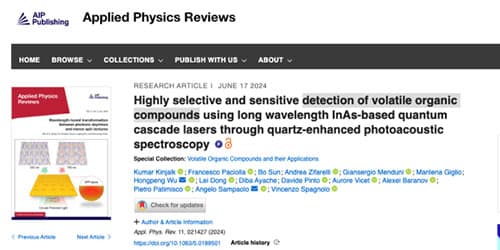
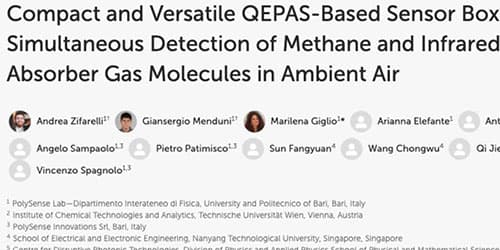
READ THE SCIENTIFIC PAPER: Partial least squares regression as novel tool for gas mixtures analysis in quartz-enhanced photoacoustic spectroscopy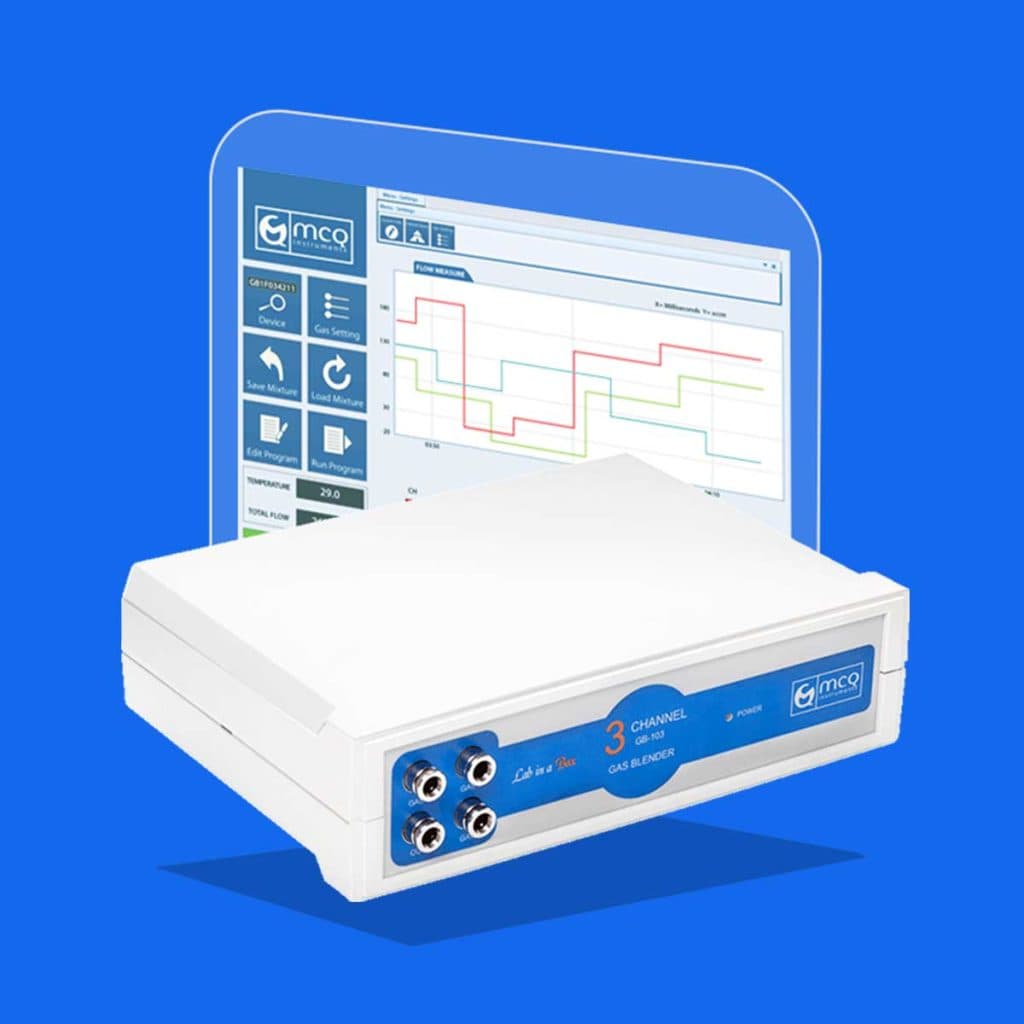
ABOUT THE UNIVERSITY
The Polytechnic University of Bari (Italian: Politecnico di Bari) is a university located in Bari, Italy. It was founded in 1990 and it is organized in 3 Faculties. In 2016, around 9752 students were enrolled. In 2013, the professors, researchers and assistants amounted to 302 people. The Polytechnic University of Bari is the youngest among the Italian polytechnic universities. Even though other Italian universities also incorporate engineering and science faculties, Italian polytechnic universities are focused on technological faculties and subjects.
Ref: WikipediaMAIN BENEFITS
- •COST AND SPACE SAVINGS. Buying cylinders of natural gas blends is expensive and limits the availability of mixtures that may be required. Gas cylinders are also large and often require special storage arrangements, as well as taking up valuable space.
- •SUCCESSFUL ACHIEVEMENT. The MCQ gas blender is used to simulate approximations of natural gas mixtures allowing on-demand, real time characterisation of sensors.
- •GAS MIXER VS. GAS CYLINDER. The ability to blend natural gas simulations on-demand is an incredibly powerful tool in the development of innovative gas detection equipment. And provides a level of flexibility that gas cylinders cannot provide.
- •FLEXIBILITY. By using the MCQ gas blender it is possible to dial up a simulation of a natural gas mixture at any time, and to a certain degree, different concentrations of the blended natural gas mixture.
- •PHYSICS OF ABSORPTION. Gas Blender allows the user to generate complex gas samples with a dilution precision compatible to the concentration accuracy level required by these investigations focused on the physics of absorption.
- •STABILITY. Thanks to our revolutionary method every gas flow has a great stability making possible to have a stable flow also for lower flow-range.