Gas Mixers for Multi-Gas Air Quality Monitoring
Calibrating photoacoustic and optical sensors for trace-level detection of atmospheric pollutants

Introduction
Air quality monitoring has moved decisively towards multi-gas instrumentation. A single modern optical sensor is now expected to quantify several pollutants at once: nitrogen dioxide and sulphur dioxide from combustion, ammonia from agriculture and industry, carbon monoxide and nitrous oxide as precursor and greenhouse species, and water vapour as an ever-present interferent. Techniques such as quartz-enhanced photoacoustic spectroscopy have made this possible in compact, field-deployable form, with detection limits reaching single parts per billion, well below the natural abundance of these species in ambient air.
Building such an instrument, however, places a very specific demand on the laboratory. Each target species must be calibrated individually across its working range, and each must then be validated in the presence of the others. The concentrations involved are extremely low, often a few parts per billion, and they must be delivered stably and reproducibly for the duration of a measurement.
There is a further requirement that is easy to overlook and decisive in practice. In photoacoustic detection the signal does not depend solely on how much of the target molecule is present. It also depends on how efficiently the absorbed energy is converted into an acoustic wave, and that conversion is governed by molecular relaxation processes which are strongly influenced by the surrounding matrix, and in particular by water vapour. A calibration performed in dry nitrogen will not correctly describe a sensor's behaviour in humid ambient air. The matrix, including its humidity, must therefore be controlled as deliberately as the analyte itself.
Sourcing this range of conditions as certified premixed cylinders is not realistic. Each concentration of each species would require its own cylinder, multi-component blends at controlled humidity are not available off the shelf, and several of the target species are toxic or corrosive, which makes holding a large cylinder inventory undesirable in itself.
Programmable gas mixing resolves the problem directly. A limited set of certified source cylinders is diluted and blended on demand, and the mixer sets not only the composition but also the flow rate delivered to the sensor, which in these instruments is typically operated under reduced and precisely regulated pressure.
This approach provides several advantages:
- •Generation of certified trace-level concentrations on demand, down to the parts-per-billion range required for ambient air monitoring
- •Independent control of several analytes within a single mixture, allowing cross-interference between species to be quantified
- •Deliberate control of the gas matrix, including humidity, which directly affects photoacoustic signal amplitude through energy relaxation
- •Regulation of the mass flow rate delivered to the acoustic detection module, alongside external pressure control
- •Complete multi-point calibration curves generated automatically, with rapid and repeatable switching between setpoints
- •A reduced inventory of hazardous certified cylinders, since mixtures are produced from a small number of sources
In conclusion, this approach makes our mixers a foundational tool for the developers of environmental analytical instrumentation, supporting the calibration and validation of sensors destined for air quality networks, greenhouse gas measurement, industrial emissions monitoring and atmospheric research.
Gas Blenders & Gas Mixer Manager
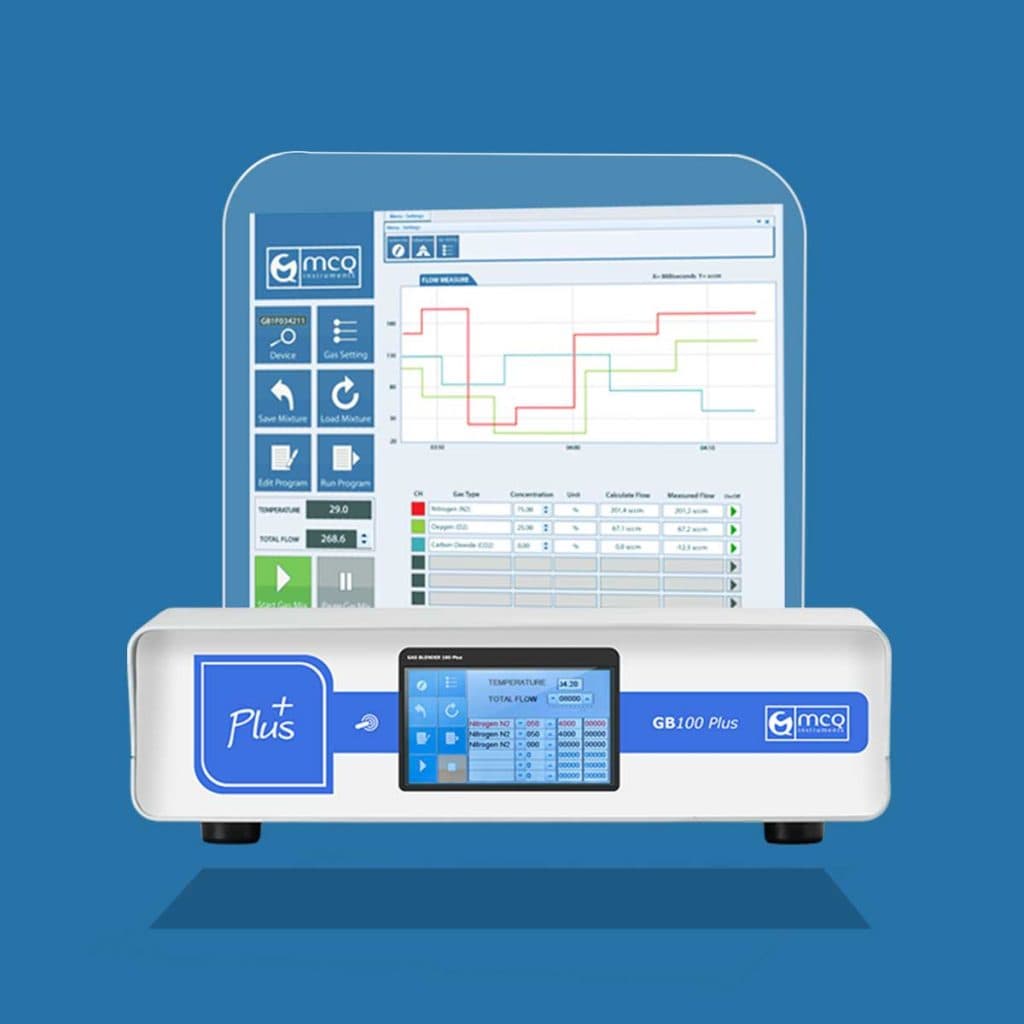
The Gas Blenders Series are the improved solutions proposed by MCQ. Designed following the Lab in Box concept, the MCQ Gas Blenders are high precision instruments, easy to configure, and adaptable to many different lab applications, they offer more efficiency and an innovative quick, and easy way for mixtures management, all in a compact case.
The Gas Blenders work with up to 6 components of gas mixtures, each gas media connected to a dedicated instrument channel for which MCQ guarantees high accuracy (1.0% of setpoint), high repeatability (0.16% of reading value), and the fastest response time for setpoint value change now available in the market.
The instruments work with dry gases and the channels are always calibrated with native gases following the customer's request. For gas mixture management, the MCQ Gas Mixture Creator Software is also provided.
Easy to use, and compatible with any common desktop or laptop PC (or touch screen for the latest products), the MCQ Software allows taking complete control over the gas mixer and its functions, letting the users start working with dynamic gas mixtures immediately with full automation.
Hardware Configuration
The gases typically used in this setup are:
- •Channel 1: Nitrogen (N₂) — matrix and diluent gas
- •Channel 2: Nitrogen dioxide (NO₂) — as a certified mixture in nitrogen
- •Channel 3: Sulphur dioxide (SO₂) — as a certified mixture in nitrogen
- •Channel 4: Ammonia (NH₃) — as a certified mixture in nitrogen
- •Channel 5: Carbon monoxide (CO), nitrous oxide (N₂O) or carbon dioxide (CO₂) — as certified mixtures, according to the target species
- •Channel 6: A second nitrogen line, which may be routed through a humidifier to set the water vapour content of the final mixture
Because the Gas Blenders accept up to six components, a single instrument can cover a multi-species calibration campaign without reconfiguring the gas line between analytes. Channel materials and seals are selected according to the reactive species involved.
The gas cylinders are connected to the instrument through 6 mm diameter tubing, and a check valve is installed on each line to prevent back-flow between channels.
Each gas is connected to and regulated by a dedicated channel of the MCQ Gas Mixer. The instrument blends the incoming gases to the target composition, and a final 6 mm outlet tube connects the mixer to the sensor gas handling system, typically an acoustic detection module or spectroscopic cell. In published sensor work the mixer sets the mass flow rate through the detection module, while a separate pressure controller, valve system and vacuum pump hold the cell at the reduced operating pressure that optimises the photoacoustic response. Reported configurations include mass flow rates of the order of tens to around a hundred standard cubic centimetres per minute at operating pressures well below atmospheric.
By adjusting the flow rates of the individual channels through the MCQ control software, developers can define each analyte concentration independently, hold a fixed matrix while varying a single species to isolate its response, introduce a controlled and constant water vapour content to prevent relaxation-driven signal drift, and program automated sequences that step through an entire calibration curve.
Institutions already using our Gas Mixers for environmental sensing research
PolySense Lab — University and Politecnico of Bari, with PolySense Innovations Srl
Quartz-Enhanced Photoacoustic Sensor Based on a Multi-Laser Source for In-Sequence Detection of NO₂, SO₂, and NH₃. Sensors vol. 23,21 9005 (2023). doi:10.3390/s23219005
This work implements a multi-quantum cascade laser module as the excitation source for a QEPAS sensor, combining three QCLs through a dichroic beam combiner into a single collimated output. The flow rate of the gas mixtures through the acoustic detection module was set by a gas mixer (MCQ Instruments, Gas Blender 103, Rome, Italy) with a setpoint accuracy of 1% for each channel, with all measurements performed at a fixed mass flow rate of 90 sccm and an operating pressure of 400 Torr. The sensor achieved minimum detection limits of 9 ppb for NO₂, 9.3 ppb for SO₂ and 2.4 ppb for NH₃ at an integration time of 100 ms, all well below the typical natural abundance of these pollutants in air.
PolySense Lab — University and Politecnico of Bari, with Technische Universität Wien and Nanyang Technological University, Singapore
Zifarelli, A., Menduni, G., Giglio, M., Elefante, A., Sukhinets, A., Sampaolo, A., Patimisco, P., Fangyuan, S., Chongwu, W., Wang, Q.J., Spagnolo, V. Compact and Versatile QEPAS-Based Sensor Box for Simultaneous Detection of Methane and Infrared Absorber Gas Molecules in Ambient Air. Frontiers in Environmental Chemistry vol. 3 926233 (2022). doi:10.3389/fenvc.2022.926233
This study presents a sensor box housing two acoustic detection modules connected in series, one coupled to an internal quantum cascade laser for methane detection and the second designed to accept an external laser source targeting any chosen infrared-absorbing species. The architecture makes the instrument adaptable to different gas combinations. As an environmental monitoring demonstration, the sensor simultaneously detected methane, a greenhouse gas, nitric oxide, an ozone-depleting substance, and water vapour in air, reaching minimum detection limits of 48 ppb for methane and 11 ppb for nitric oxide.
Multi-species environmental monitoring with a Vernier-effect laser source
Multi-gas quartz-enhanced photoacoustic sensor for environmental monitoring exploiting a Vernier effect-based quantum cascade laser.
Here a Vernier effect-based quantum cascade laser, whose emission spectrum comprises ten separated clusters spanning 2100 to 2250 cm⁻¹, was used to address the absorption features of carbon monoxide, nitrous oxide, carbon dioxide and water vapour. The sensor was calibrated with certified concentrations of CO, N₂O and CO₂ in a wet nitrogen matrix, with the water vapour concentration in the gas line deliberately fixed to prevent alterations of the QEPAS signal caused by energy relaxation effects. Minimum detection limits of 6 ppb, 7 ppb and 70 ppm were achieved for CO, N₂O and CO₂ respectively at 100 ms integration time, and the instrument was then validated by sampling indoor laboratory air.
References
- •Quartz-Enhanced Photoacoustic Sensor Based on a Multi-Laser Source for In-Sequence Detection of NO₂, SO₂, and NH₃. Sensors vol. 23,21 9005 (2023). doi:10.3390/s23219005
- •Zifarelli, A et al. Compact and Versatile QEPAS-Based Sensor Box for Simultaneous Detection of Methane and Infrared Absorber Gas Molecules in Ambient Air. Frontiers in Environmental Chemistry vol. 3 926233 (2022). doi:10.3389/fenvc.2022.926233
- •Multi-gas quartz-enhanced photoacoustic sensor for environmental monitoring exploiting a Vernier effect-based quantum cascade laser. Photoacoustics (2022).
- •Greenhouse Gases Detection Exploiting a Multi-Wavelength Interband Cascade Laser Source in a Quartz-Enhanced Photoacoustic Sensor. Sensors (2024).
- •Patimisco, P et al. Recent advances in quartz enhanced photoacoustic sensing. Applied Physics Reviews vol. 5 011106 (2018). doi:10.1063/1.5013612