Controlled Gas Environments for Microbiology Research
Optimize microbial growth and experimental reproducibility with high-accuracy gas mixers engineered for advanced research laboratories.
Introduction
Gas composition is a critical variable in microbiology, influencing microbial growth, metabolism, and community dynamics. Many microorganisms rely on specific gaseous environments for their survival and activity, including aerobic, microaerophilic, and anaerobic conditions.
In addition to oxygen, gases such as carbon dioxide (CO₂), hydrogen (H₂), methane (CH₄), and nitrogen (N₂) play essential roles in microbial physiology and energy metabolism.
In natural and industrial environments, microorganisms are exposed to complex and dynamic gas compositions. However, reproducing these conditions in the laboratory can be challenging, particularly when precise control of gas ratios and partial pressures is required.
This is particularly relevant in closed systems, where the composition of the headspace directly determines gas availability to the microorganisms.
Gas Composition as a Key Experimental Variable
In microbiology, small variations in gas composition can significantly impact experimental outcomes, this is especially critical in headspace-controlled systems, where gas-liquid equilibrium influences microbial activity:
- •Microaerophilic organisms require tightly controlled low oxygen levels
- •Strict anaerobes are highly sensitive to even trace amounts of oxygen
- •Chemolithotrophic microorganisms depend on gases such as H₂, CO₂, or CH₄ as energy and carbon sources
- •Gas composition influences fermentation pathways and metabolic product yields
For these reasons, the ability to precisely control and adjust gas environments is essential for reproducible and physiologically relevant experiments.
Challenges in Conventional Setups
Traditional approaches often rely on premixed gas cylinders, gas packs, or anaerobic chambers. While these methods are widely used, they present several limitations:
- •Limited flexibility in testing different gas compositions
- •Reliance on multiple premixed gas supplies
- •Variability introduced by manual gas handling
- •Difficulty in maintaining stable conditions over time
- •Limited ability to perform systematic gas titration experiments
- •Limited control and reproducibility of headspace composition in sealed cultures
These constraints can make it difficult to explore how microorganisms respond to different gas conditions or to optimize experimental parameters efficiently.
Gas Mixers for Microbiology Applications
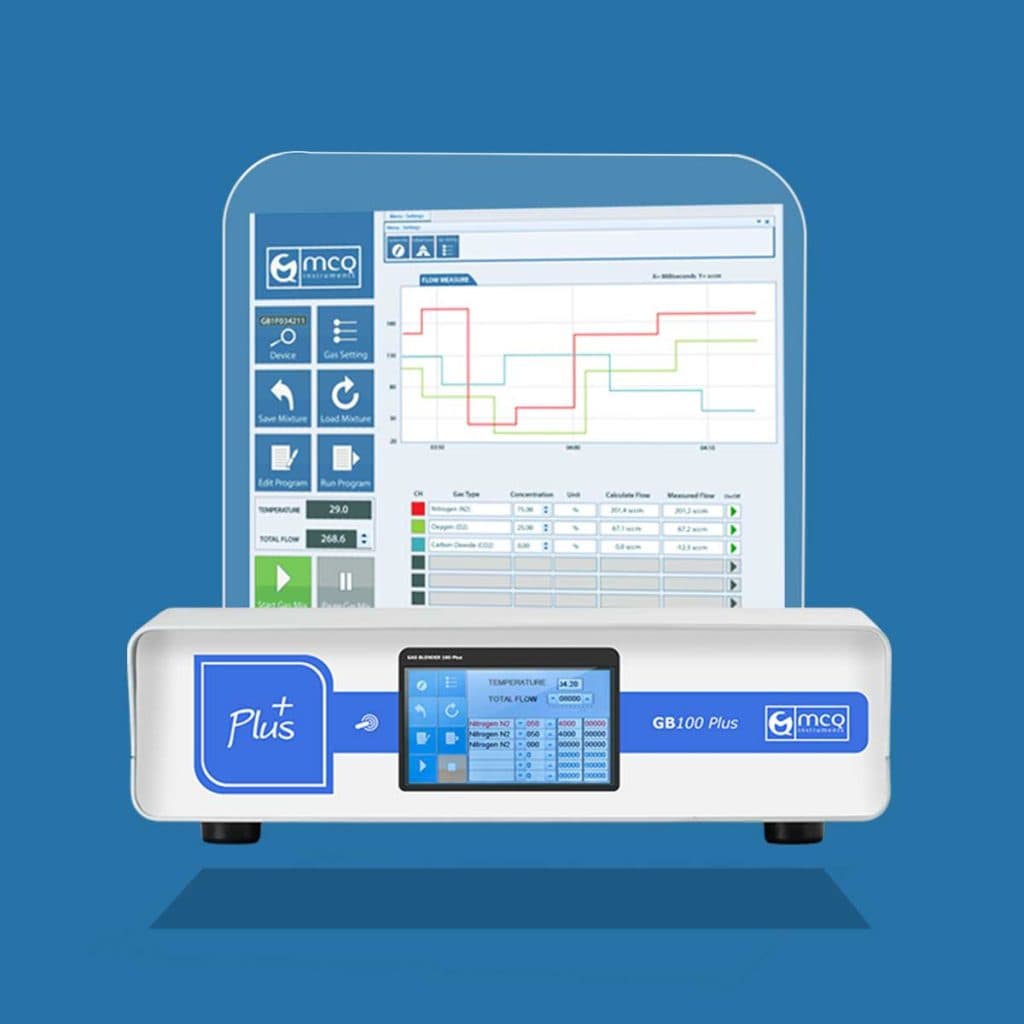
Programmable gas mixing systems provide a versatile solution for generating precise and reproducible gas mixtures tailored to microbiological applications.
By blending gases such as O₂, CO₂, N₂, H₂, or CH₄, gas mixers allow researchers to create controlled environments that closely match the requirements of specific microorganisms, this includes precise control of the headspace composition in sealed culture systems.
Gas composition can be modified directly through the instrument software, allowing both fixed gas conditions and dynamic gas profiles to be implemented.
Key Advantages
- •Strict control of microaerophilic and anaerobic conditions: Gas mixers allow accurate adjustment of oxygen levels, enabling the cultivation of sensitive microorganisms under tightly controlled conditions.
- •Reproducibility of gas-dependent experiments: Highprecision gas control ensures stable and uniform headspace conditions across all experiments, eliminating operatordependent variability and delivering consistent, reproducible microbiology results.
- •Gas titration experiments: Researchers can systematically vary gas composition to study microbial responses across different conditions and identify optimal growth parameters.
- •Support for gas-utilizing microorganisms: Precise control of gases such as H₂, CO₂, and CH₄ enables studies on chemolithotrophic and autotrophic microorganisms.
- •Process optimization and scalability: Gas conditions identified in small-scale experiments can be transferred to larger systems such as fermenters or industrial bioprocesses.
Applications
Gas mixing systems are widely used in microbiology research, including:
- •Cultivation of anaerobic and microaerophilic microorganisms in controlled headspace conditions
- •Fermentation and metabolic pathway studies
- •Microbial ecology and community dynamics
- •Biogas and methane-related research
- •Carbon capture and utilization (CCU) processes
- •Bioprocess development and optimization
Hardware Configuration
An example of MCQ Gas Mixer hardware configuration for microbiology applications is illustrated in the schematic setup. The gases typically used in this configuration are:
- •Channel 1: Nitrogen (N₂)
- •Channel 2: Carbon dioxide (CO₂)
- •Channel 3: Oxygen (O₂)
- •Channel 4: Hydrogen (H₂) or other specialty gases (e.g., CH₄) depending on the microbial system
All gases should be supplied in dry and high-purity form to ensure accurate and reproducible experimental conditions, especially for sensitive anaerobic or microaerophilic organisms. Gas cylinders are connected to the instrument through 6 mm diameter tubing, and a check valve is installed on each line to prevent back-flow and cross-contamination.
Each gas is connected to and controlled by a dedicated channel of the MCQ Gas Mixer. The system blends the gases to generate precise and stable gas mixtures, which are delivered via an outlet line (6 mm tubing) to the experimental setup. In sealed systems such as serum bottles or culture vials, the generated gas mixture defines the composition of the headspace, which equilibrates with the liquid phase and directly impacts microbial growth.
Depending on the application, the gas mixture can be supplied to a variety of microbiology systems, including:
- •Serum bottles or sealed culture vials for batch microbial growth experiments
- •Anaerobic chambers or glove boxes for strict anaerobe handling
- •Bioreactors and fermenters for controlled microbial cultivation
- •Balch tubes or Hungate tubes for anaerobic techniques
- •Gas-tight culture bags for flexible or disposable setups
The MCQ Gas Mixer allows researchers to establish static gas environments (e.g., fixed microaerophilic or anaerobic conditions) or implement dynamic gas profiles, such as gradual oxygen depletion or controlled introduction of reactive gases. Gas composition can be precisely adjusted and programmed through the MCQ software, enabling reproducible experimental workflows.
In applications involving long-term cultures or gas-consuming microorganisms, maintaining a continuous and stable gas flow is essential to ensure a constant headspace composition, particularly in closed or semi-closed systems. The MCQ Gas Mixer ensures consistent gas composition over time, reducing variability associated with manual gas handling and enabling highly reproducible microbiological experiments.
Institutions using our gas mixers to improve the reliability of Microbiology research:
University of Wisconsin-Madison: Prof. Patricia J. Kiley Lab:
Banerjee, et al. The Role of the [2Fe-2S] Cluster of Escherichia coli IscR in Responding to Redox-Cycling Agents. Molecular microbiology vol. 124,5 (2025): 433-448. doi:10.1111/mmi.70021
Pivot Bio, Inc.:
Martinez-Feria, et al. Genetic remodeling of soil diazotrophs enables partial replacement of synthetic nitrogen fertilizer with biological nitrogen fixation in maize. Scientific reports vol. 14,1 27754. 12 Nov. 2024, doi:10.1038/s41598-024-78243-3
Wageningen University: Prof. Dr. Diana Sousa:
Cantera, et al. Microbial conversion of carbon dioxide and hydrogen into the fine chemicals hydroxyectoine and ectoine. Bioresource technology vol. 374 (2023): 128753. doi:10.1016/j.biortech.2023.128753
Technical University Berlin: Dr. Oliver Lenz Lab:
Jahn, et al. The energy metabolism of Cupriavidus necator in different trophic conditions. Applied and environmental microbiology vol. 90,10 (2024): e0074824. doi:10.1128/aem.00748-24
Friedrich Schiller University Jena: Prof. Dr. Kirsten Küsel Lab:
Hädrich, et al. Microbial Fe(II) oxidation by Sideroxydans lithotrophicus ES-1 in the presence of Schlöppnerbrunnen fen-derived humic acids. FEMS microbiology ecology vol. 95,4 (2019): fiz034. doi:10.1093/femsec/fiz034
Université de Rennes: Dr. Alexis Dufresne Lab:
Garry, et al. Ferriphaselus amnicola strain GF-20, a new iron- and thiosulfate-oxidizing bacterium isolated from a hard rock aquifer. FEMS microbiology ecology vol. 100,5 (2024): fiae047. doi:10.1093/femsec/fiae047
References
- •Yu, et al. Effects of elevated carbon dioxide on environmental microbes and its mechanisms: A review. The Science of the total environment vol. 655 (2019): 865-879. doi:10.1016/j.scitotenv.2018.11.301
- •Teng, et al. Function of Biohydrogen Metabolism and Related Microbial Communities in Environmental Bioremediation. Frontiers in microbiology vol. 10 106. 14 Feb. 2019, doi:10.3389/fmicb.2019.00106
- •Reis, et al. The role of methanotrophy in the microbial carbon metabolism of temperate lakes. Nature communications vol. 13,1 43. 10 Jan. 2022, doi:10.1038/s41467-021-27718-2
- •Pi, Hong-Wei et al. Origin and Evolution of Nitrogen Fixation in Prokaryotes. Molecular biology and evolution vol. 39,9 (2022): msac181. doi:10.1093/molbev/msac181