Gas Mixer for Ex Vivo Human Brain Perfusion — Bexorg
Precise oxygen and gas control for a preclinical drug testing platform built on perfused human brain tissue
Introduction
Bexorg, Inc., based in New Haven, Connecticut, is doing something that did not exist a decade ago: keeping human brain tissue metabolically alive outside the body, and using it as a testing platform for neurological drugs.
The company was founded by Nenad Sestan and Zvonimir Vrselja, the Yale researchers behind BrainEx, the perfusion technology that in 2019 restored circulation and cellular function in the isolated large mammalian brain hours after death, and whose findings were published in Nature. Bexorg has since brought that technology to human tissue and built it into a preclinical research platform.
The scientific proposition is significant. Neurological drug development has long depended on animal models whose brains differ from ours in ways that matter, and a great deal of promising neuroscience has failed in translation as a result. Perfused human brain tissue offers investigators the ability to ask questions directly of the tissue they are ultimately trying to treat: whether a compound actually reaches brain tissue, how that tissue responds across a range of doses, whether early signs of toxicity appear, and which biomarkers are released in response.
Keeping that tissue viable is the hard part, and the brain is the most demanding organ on which to attempt it.
The brain consumes a disproportionate share of the body's oxygen and is the tissue least tolerant of interruption in supply. Sustaining it outside the body means circulating a warmed, oxygen-carrying perfusate through its vasculature at body temperature and delivering oxygen continuously through a membrane oxygenator. Two parameters must be held at once, and they are coupled.
The first is oxygenation. The perfusate must carry enough oxygen to meet metabolic demand, but no more than that. Excess oxygen is not a safety margin: hyperoxic perfusion drives the formation of reactive oxygen species and contributes directly to reperfusion injury, precisely the damage the platform exists to avoid. The oxygen fraction has to be set to a defined target and held there.
The second is pH. A perfusion circuit has no lungs and no kidneys, so the acid-base balance a living body regulates automatically must be managed through the gas phase. Because perfusate pH is governed largely by dissolved carbon dioxide, raising the nitrogen flow through the oxygenator strips CO₂ and raises pH, while a dedicated CO₂ channel supplies the partial pressure required to bring it back down. The physiological window is narrow.
These two controls interact. Increasing nitrogen flow to correct pH simultaneously lowers the oxygen partial pressure, so the oxygen channel must compensate in the same moment. Holding tissue in physiological balance for hours therefore means continuously and independently regulating two or three gases in response to blood-gas measurements taken from the circuit.
MCQ Gas Mixers provide the precise oxygen and gas control on which the Bexorg platform depends.
There is a further requirement that goes beyond keeping the tissue alive, and it is the one that matters most to a testing platform. Bexorg's purpose is comparative pharmacology: many compounds, many doses, many specimens. A result is only interpretable if the conditions under which it was obtained can be reproduced exactly for the next run. Gas conditions that drift between experiments do not merely degrade an individual result — they undermine the comparison the entire platform exists to make. Stability and reproducibility are not conveniences here; they are what makes the data mean anything.
This approach provides several advantages:
- •Independent regulation of O₂, CO₂ and N₂ into the membrane oxygenator, allowing oxygenation and pH to be controlled separately despite being physically coupled
- •Precise delivery of a defined oxygen fraction, avoiding the hyperoxia associated with reperfusion injury
- •Adjustment of the mixture during perfusion, in response to blood-gas analysis of the circulating perfusate
- •Stable, reproducible conditions across long experiments and, critically, between separate runs in a testing campaign
- •A single instrument covering the full range of conditions the tissue passes through, from initial perfusion to normothermic steady state
- •Programmable profiles, where a protocol calls for oxygenation to be deliberately varied
In conclusion, the Bexorg platform illustrates what precise gas control makes possible at the outer edge of what perfusion technology can currently achieve — and the same requirements apply across ex vivo organ perfusion generally, from transplantation research to isolated organ physiology.
Gas Blenders & Gas Mixer Manager
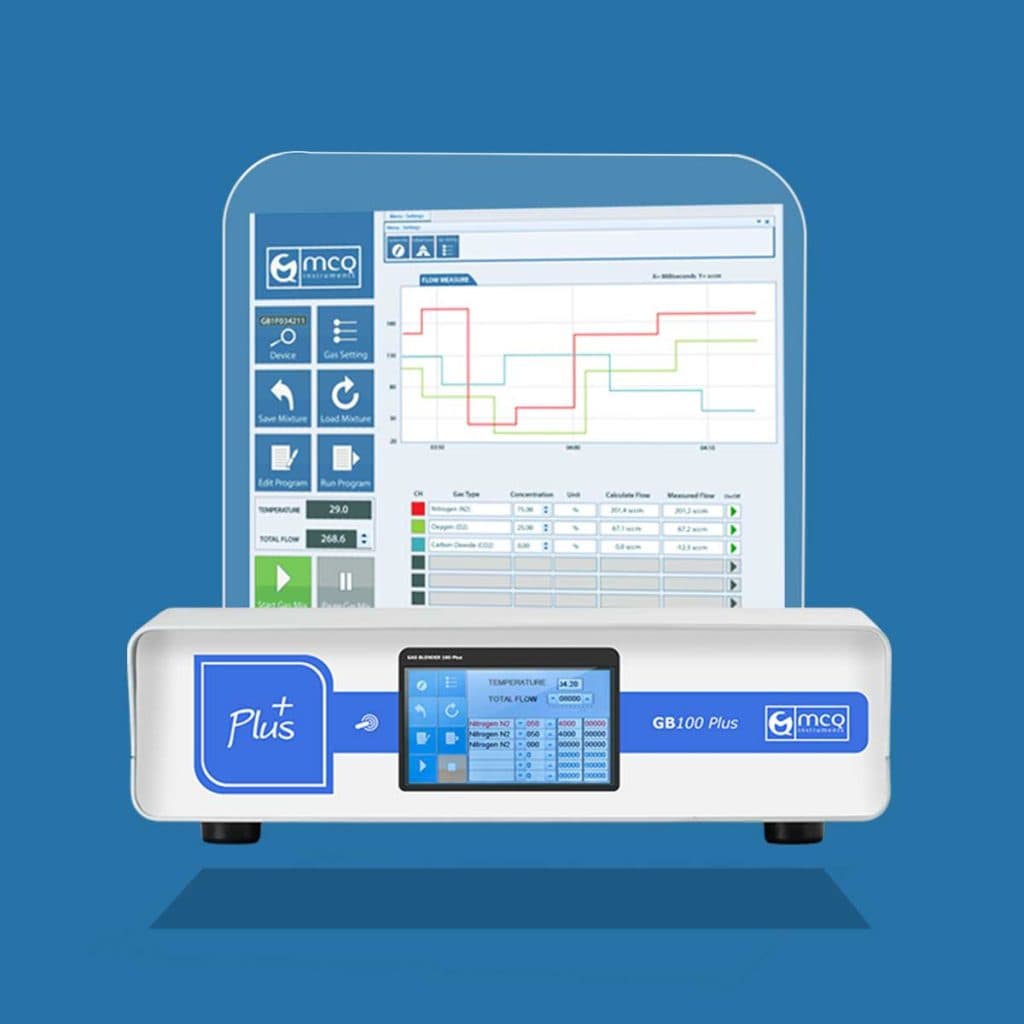
The Gas Blenders Series are the improved solutions proposed by MCQ. Designed following the Lab in Box concept, the MCQ Gas Blenders are high precision instruments, easy to configure, and adaptable to many different lab applications, they offer more efficiency and an innovative quick, and easy way for mixtures management, all in a compact case.
The Gas Blenders work with up to 6 components of gas mixtures, each gas media connected to a dedicated instrument channel for which MCQ guarantees high accuracy (1.0% of setpoint), high repeatability (0.16% of reading value), and the fastest response time for setpoint value change now available in the market.
The instruments work with dry gases and the channels are always calibrated with native gases following the customer's request. For gas mixture management, the MCQ Gas Mixture Creator Software is also provided.
Easy to use, and compatible with any common desktop or laptop PC (or touch screen for the latest products), the MCQ Software allows taking complete control over the gas mixer and its functions, letting the users start working with dynamic gas mixtures immediately with full automation.
Hardware Configuration
The gases typically used in this setup are:
- •Channel 1: Oxygen (O₂) — to meet the metabolic demand of the perfused tissue
- •Channel 2: Nitrogen (N₂) — as balance gas, and to strip CO₂ from the perfusate in order to raise pH
- •Channel 3: Carbon dioxide (CO₂) — to establish the required partial pressure and lower pH, particularly early in perfusion when the tissue produces little CO₂ of its own
The gas cylinders are connected to the instrument through 6 mm diameter tubing, and a check valve is installed on each line to prevent back-flow between channels.
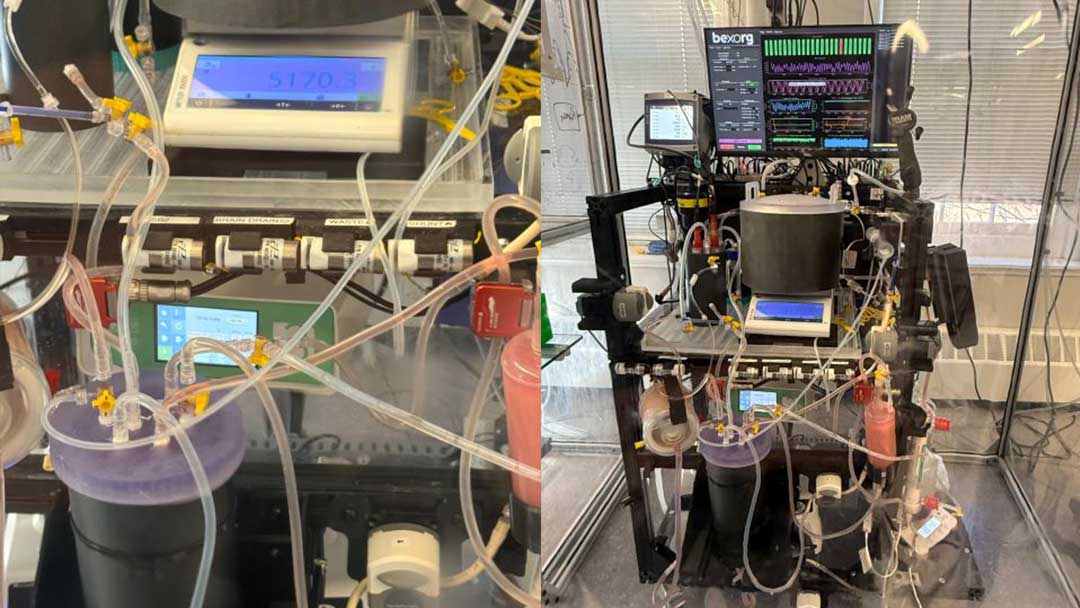
Each gas is connected to and regulated by a dedicated channel of the MCQ Gas Mixer. The instrument blends the incoming gases to the required composition, and the outlet line feeds the gas inlet of the membrane oxygenator within the perfusion circuit, where exchange with the circulating perfusate takes place. In published perfusion architectures the gas supply is filtered before reaching the oxygenator, and the blended gas line is treated as a defined component of the circuit alongside the pulsatile pump, heat exchanger and reservoir.
The channels operate simultaneously, so oxygenation and acid-base balance can be addressed as separate controls rather than as a single compromise. In practice the operator samples the perfusate for blood-gas analysis and adjusts the setpoints accordingly: raising the oxygen flow if the partial pressure of oxygen or the saturation falls below target, and adjusting the nitrogen and carbon dioxide flows to bring pH back within the physiological window, compensating on the oxygen channel at the same time.
Because the MCQ control software allows setpoints to be changed on the fly and sequences to be programmed and saved, the same configuration can be reproduced precisely from one experiment to the next — which is what allows results from separate runs to be compared with confidence.
About the Bexorg platform
Bexorg operates its perfusion systems in laboratories in New Haven, Connecticut, close to the Yale School of Medicine where the underlying technology was developed. Human brain tissue is maintained under normothermic conditions on a custom pulsatile perfusion circuit, with cellular viability supported by a haemoglobin-based acellular perfusate designed to promote recovery from anoxia, limit reperfusion injury and prevent oedema.
The tissue is received without electrical activity and is deliberately maintained in that state throughout. What the platform sustains is cellular and metabolic viability, not neural activity.
On this basis, investigators can evaluate compounds directly against human brain tissue: assessing penetration, dose response, early toxicity signals and biomarker release. The company positions the technology as an alternative to animal models in preclinical neuroscience — an approach that has drawn interest from neuroscience drug developers and that aligns with a broader regulatory movement toward reducing reliance on animal testing.
The underlying science is documented in the peer-reviewed literature. The 2019 Nature paper by Vrselja, Daniele, Silbereis and colleagues reported the restoration and maintenance of microcirculation and molecular and cellular function in the intact large mammalian brain under ex vivo normothermic conditions, using a custom pulsatile perfusion device and a haemoglobin-based, non-coagulative, cytoprotective perfusate. The 2022 Nature paper by Andrijevic, Vrselja, Lysyy and colleagues extended the approach from a single organ to whole-body application.
References
- •Vrselja, Z., Daniele, S.G., Silbereis, J. et al. Restoration of brain circulation and cellular functions hours post-mortem. Nature vol. 568 (2019): 336-343. doi:10.1038/s41586-019-1099-1
- •Andrijevic, D., Vrselja, Z., Lysyy, T. et al. Cellular recovery after prolonged warm ischaemia of the whole body. Nature vol. 608 (2022): 405-412. doi:10.1038/s41586-022-05016-1
- •Sestan, N., Vrselja, Z. et al. Methods, systems and compositions for normothermic ex vivo restoration and preservation of intact organs. Patent US 11998001