Gas Mixers for Sleep Apnea and Intermittent Hypoxia Models in Cancer Research
Recreating the oxygen cycles of obstructive sleep apnea to study tumor growth and progression
Introduction
Obstructive sleep apnea (OSA) is a common chronic respiratory disorder estimated to affect close to one billion people worldwide. Its defining feature is nocturnal intermittent hypoxia: repeated cycles in which blood and tissue oxygen levels fall during an apneic episode and are then rapidly restored on reoxygenation. A growing body of epidemiological and experimental evidence links this intermittent hypoxia to higher rates of cancer development and poorer cancer outcomes.
Understanding this link requires reproducing, at the cellular level, the specific oxygen pattern that OSA patients experience. This is fundamentally different from chronic hypoxia. Where chronic hypoxia is a sustained low-oxygen state, intermittent hypoxia is a rapid, repeated oscillation between low and restored oxygen, and the two activate the hypoxic and inflammatory pathways in distinct ways. Studying the cancer connection therefore depends on the ability to deliver fast, controlled, repeatable cycles of oxygen to cells and tissues.
This is precisely where conventional approaches struggle. Traditional intermittent hypoxia models alternate the gas atmosphere over cells bathed in culture media, but the slow equilibration between the gas phase and the liquid medium limits how quickly the oxygen actually experienced by the cells can change. Large swings in the chamber atmosphere can translate into only small fluctuations at the cell surface, meaning the intended hypoxic cycle is never truly delivered.
Programmable gas mixing systems overcome this limitation. By precisely controlling the oxygen concentration delivered to a small, rapidly renewed chamber, and by automatically switching between normoxic and hypoxic setpoints on a defined schedule, a gas mixer can reproduce the rapid cyclical oxygen changes characteristic of OSA at the cellular level.
This approach provides several advantages:
- •Faithful reproduction of OSA-like intermittent hypoxia, with rapid switching between normoxia and hypoxia
- •Precise, reproducible control of oxygen concentration at each setpoint
- •Programmable cycle timing, frequency, and duration to match physiological apnea patterns
- •The ability to study intermittent hypoxia and chronic hypoxia within the same controlled system
- •Consistent, well-defined exposure conditions that improve the comparability and reproducibility of results
By importing a dynamic program into the instrument, researchers can recreate a full night of apneic cycles, or any custom protocol, and investigate how the resulting oxygen oscillations influence cancer cell proliferation, migration, signalling, and metastatic potential.
In conclusion, this approach makes our mixers a powerful enabling tool for one of the most active frontiers in oncology research: clarifying the mechanisms by which obstructive sleep apnea contributes to cancer development and progression, and exploring how these effects might be prevented.
Gas Blenders & Gas Mixer Manager
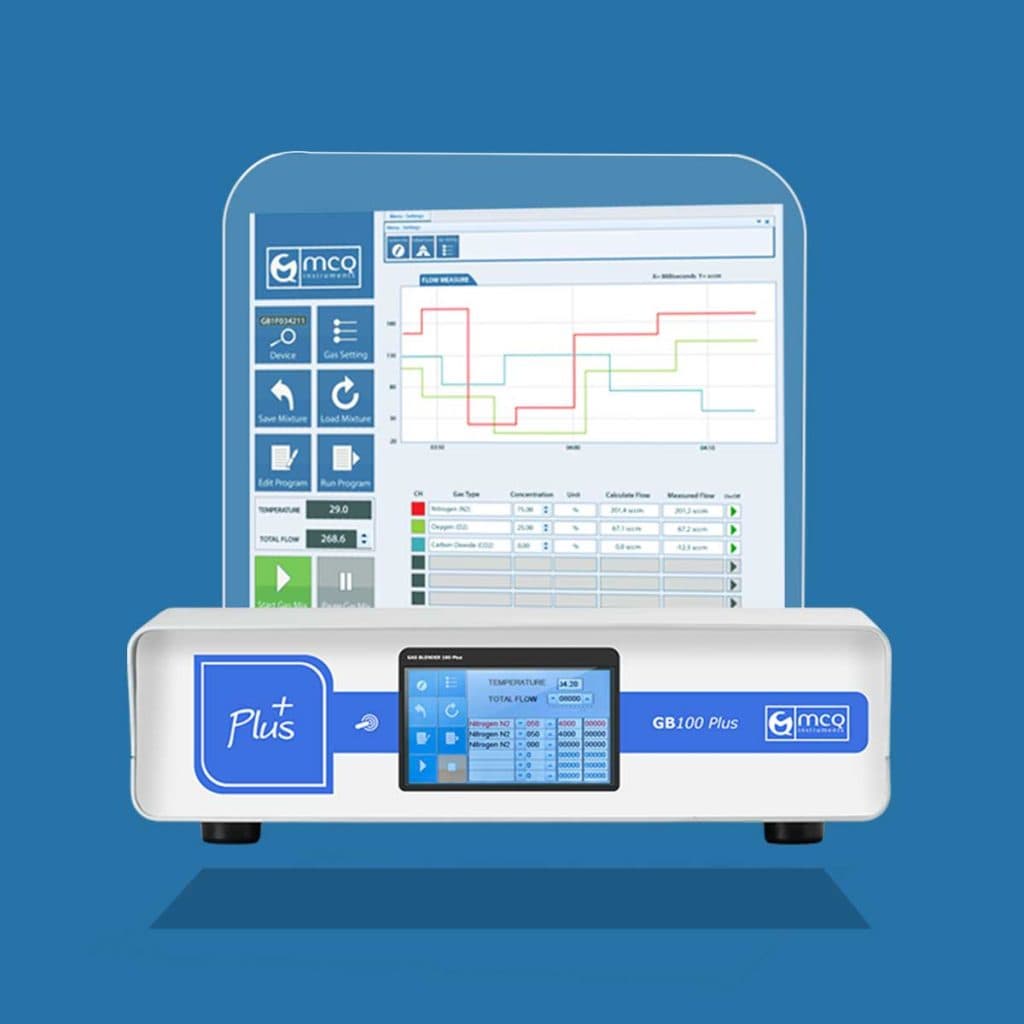
The Gas Blenders Series are the improved solutions proposed by MCQ. Designed following the Lab in Box concept, the MCQ Gas Blenders are high precision instruments, easy to configure, and adaptable to many different lab applications, they offer more efficiency and an innovative quick, and easy way for mixtures management, all in a compact case.
The Gas Blenders work with up to 6 components of gas mixtures, each gas media connected to a dedicated instrument channel for which MCQ guarantees high accuracy (1.0% of setpoint), high repeatability (0.16% of reading value), and the fastest response time for setpoint value change now available in the market.
The instruments work with dry gases and the channels are always calibrated with native gases following the customer's request. For gas mixture management, the MCQ Gas Mixture Creator Software is also provided.
Easy to use, and compatible with any common desktop or laptop PC (or touch screen for the latest products), the MCQ Software allows taking complete control over the gas mixer and its functions, letting the users start working with dynamic gas mixtures immediately with full automation.
Hardware Configuration
The gases typically used in this setup are:
- •Channel 1: Nitrogen (N₂) — used to lower oxygen during the hypoxic phase
- •Channel 2: Oxygen (O₂) — used to restore oxygen during the normoxic phase
- •Channel 3: Carbon dioxide (CO₂) — to maintain physiological CO₂ levels in the culture environment
The pure gas cylinders are connected to the instrument through 6 mm diameter tubing, and a check valve is installed on each line to prevent back-flow between channels.
Each gas is connected to and regulated by a dedicated channel of the MCQ Gas Mixer. The instrument blends the incoming gases to generate the precise oxygen concentrations required for each phase of the intermittent hypoxia cycle. A final 6 mm outlet tube connects the mixer to the experimental system, typically a small chamber or custom plate holder containing cells cultured on gas-permeable dishes, hosted within a standard cell culture incubator.
The channels operate simultaneously to produce the desired gas mixture, and the control software switches between the normoxic and hypoxic setpoints according to the programmed schedule. Because the small volume of gas in the chamber or holder is rapidly renewed, the oxygen concentration experienced by the cells changes quickly, allowing the system to reproduce the fast intermittent hypoxia cycles seen in obstructive sleep apnea. By adjusting the setpoints and the cycle timing through the MCQ control software, researchers can precisely define the depth, frequency, and duration of the hypoxic episodes.
Institutions already using our Gas Mixers for intermittent hypoxia and cancer research
Grenoble Alpes University: Prof. Diane Godin-Ribuot Lab (HP2 Laboratory, hypoxia and cardiovascular consequences of OSA):
Minoves et al. Chronic intermittent hypoxia, a hallmark of obstructive sleep apnea, promotes 4T1 breast cancer development through endothelin-1 receptors. Scientific Reports vol. 12,1 12916. 28 Jul. 2022, doi:10.1038/s41598-022-15541-8. In this study, cultured 4T1 breast cancer cells were exposed to intermittent hypoxia cycles alternating 5 minutes of normoxia and 5 minutes of hypoxia using custom plate holders connected to a Gas Blender 100 (MCQ Instruments, Rome, Italy) within a standard cell culture incubator.
University of Auckland / research on OSA tissue oxygenation (HIF-1 dose-dependent activation):
Emerging cell-based models of physiological OSA tissue oxygenation use a programmable gas blender to control oxygen delivery to a small chamber containing cells grown on oxygen-permeable dishes, enabling the study of intermittent hypoxia effects in HCT116 colorectal carcinoma cells. Obstructive Sleep Apnea Activates HIF-1 in a Hypoxia Dose-Dependent Manner in HCT116 Colorectal Carcinoma Cells. International Journal of Molecular Sciences vol. 20,2 445. 21 Jan. 2019, doi:10.3390/ijms20020445
References
- •Minoves, M et al. Chronic intermittent hypoxia, a hallmark of obstructive sleep apnea, promotes 4T1 breast cancer development through endothelin-1 receptors. Scientific Reports vol. 12,1 12916. 28 Jul. 2022, doi:10.1038/s41598-022-15541-8
- •Obstructive Sleep Apnea Activates HIF-1 in a Hypoxia Dose-Dependent Manner in HCT116 Colorectal Carcinoma Cells. International Journal of Molecular Sciences vol. 20,2 445. 21 Jan. 2019, doi:10.3390/ijms20020445
- •Models of intermittent hypoxia and obstructive sleep apnea: molecular pathways and their contribution to cancer. American Journal of Physiology - Regulatory, Integrative and Comparative Physiology (2018). doi:10.1152/ajpregu.00036.2018
- •Campillo, N et al. A Novel Chip for Cyclic Stretch and Intermittent Hypoxia Cell Exposures Mimicking Obstructive Sleep Apnea. Frontiers in Physiology vol. 7 319. 26 Jul. 2016, doi:10.3389/fphys.2016.00319