Gas mixers for Hypoxia Studies
Helping you setting reproducible hypoxia models through programmable gas mixing

How precisely are you controlling oxygen in your hypoxia experiments?
Oxygen availability is a key environmental parameter regulating cellular metabolism, gene expression, and stress response pathways. In living tissues, oxygen concentration varies significantly depending on vascularization, metabolic activity, and local diffusion gradients.
Hypoxia research has become increasingly important across multiple fields of biology, including cancer research, stem cell biology, immunology, and metabolic studies. Investigating cellular responses to reduced oxygen availability allows researchers to better understand mechanisms such as hypoxia-inducible factor (HIF) signaling, metabolic adaptation, and oxidative stress regulation.
However, accurately reproducing hypoxic environments in vitro requires precise and reproducible control of oxygen concentration. Traditional approaches often rely on static gas environments generated by premixed gas cylinders or hypoxia chambers, which can limit experimental flexibility and make it difficult to explore how biological systems respond across a range of oxygen conditions.
Programmable gas mixing systems provide a powerful solution to this challenge by enabling researchers to precisely control oxygen concentration and dynamically adjust gas compositions during experiments. This capability allows the implementation of oxygen titration experiments, the reproduction of physiologically relevant oxygen conditions, and the generation of more detailed datasets on oxygen-dependent cellular processes.
Hypoxia Research and the Importance of Oxygen Control
In experimental systems, hypoxia is typically induced by reducing oxygen concentration within an incubator. However, conventional approaches often rely on static gas environments, manual adjustments of gas mixtures or reliance on multiple premixed cylinders that can introduce variability and reduce experimental reproducibility.
Instead of manually changing gas cylinders or preparing multiple premixed mixtures, researchers can define a sequence of oxygen setpoints directly through the instrument software. The system then automatically generates the required gas compositions and maintains stable atmospheric conditions within the experimental environment.
This capability enables the implementation of dynamic oxygen modulation, including:
- •Stepwise oxygen titration experiments
- •Gradual oxygen ramps
- •Cyclic/intermittent hypoxia protocols
Moreover, programmable gas mixing systems address this challenge by maintaining stable and reproducible oxygen conditions throughout the experiment. This level of control improves data consistency, facilitates cross-experiment comparisons, and strengthens the reproducibility of experimental findings.
In conclusion, precise control of oxygen concentration is becoming essential for studying hypoxia and understanding oxygen-dependent cellular processes. Programmable gas mixers enable researchers to generate stable and reproducible gas environments, while also allowing dynamic adjustment of oxygen levels during experiments.
This flexibility supports oxygen titration studies, improves experimental reproducibility, and helps researchers reproduce physiologically relevant conditions in vitro. As a result, gas mixing technologies provide a valuable tool for advancing hypoxia research across a wide range of biological and biomedical fields.
Gas Blenders & Gas Mixer Manager
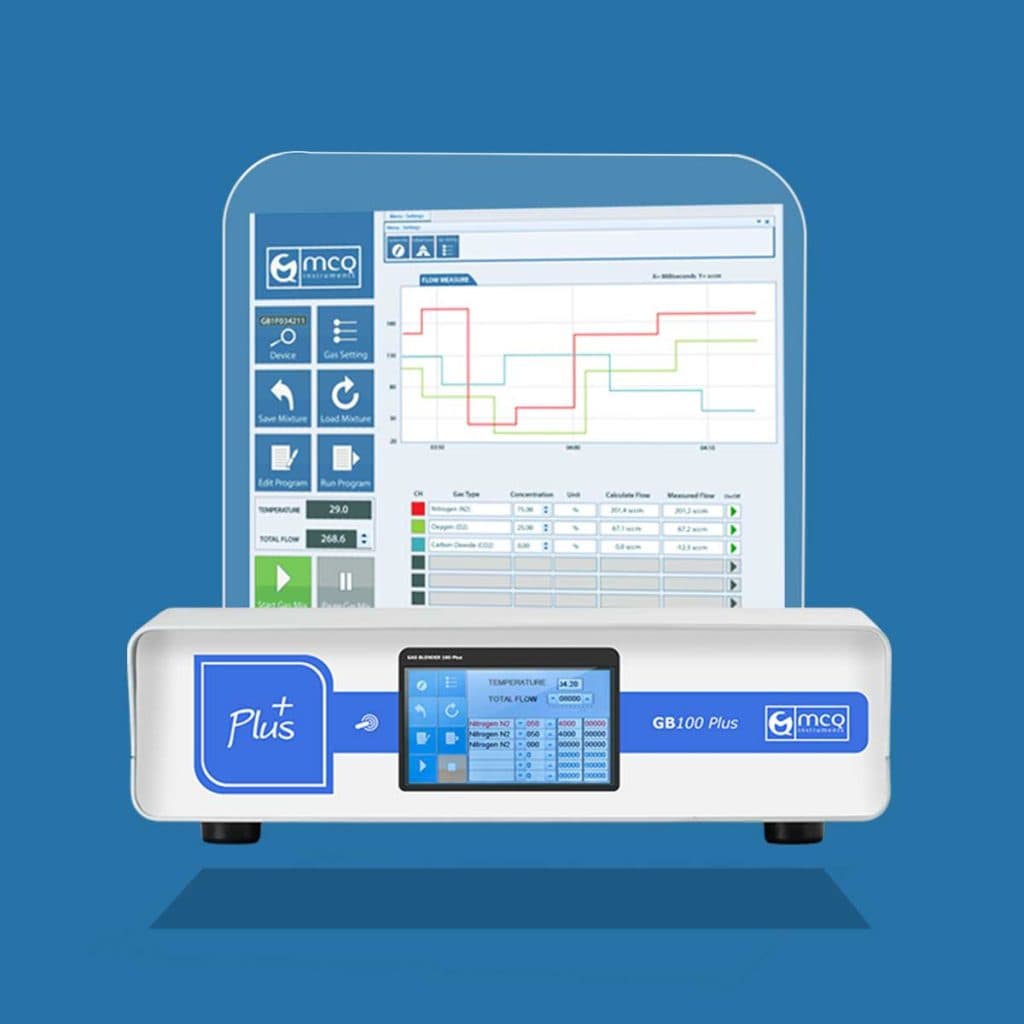
The Gas Blenders Series are the improved solutions proposed by MCQ. Designed following the Lab in Box concept, the MCQ Gas Blenders are high precision instruments, easy to configure, and adaptable to many different lab applications, they offer more efficiency and an innovative quick, and easy way for mixtures management, all in a compact case.
The Gas Blenders work with up to 6 components of gas mixtures, each gas media connected to a dedicated instrument channel for which MCQ guarantees high accuracy (1.0% of setpoint), high repeatability (0.16% of reading value), and the fastest response time for setpoint value change now available in the market.
The instruments work with dry gases and the channels are always calibrated with native gases following the customer's request. For gas mixture management, the MCQ Gas Mixture Creator Software is also provided.
Easy to use, and compatible with any common desktop or laptop PC (or touch screen for the latest products), the MCQ Software allows taking complete control over the gas mixer and its functions, letting the users start working with dynamic gas mixtures immediately with full automation.
Hardware Configuration
An example of MCQ Gas Mixer hardware configuration for hypoxia research is illustrated in the schematic diagram. The gases typically used in this setup are:
- •Channel 1: Nitrogen (N₂)
- •Channel 2: Oxygen (O₂)
- •Channel 3: Carbon dioxide (CO₂)
The pure gas cylinders are connected to the instrument through 6 mm diameter tubing, and a check valve is installed on each line to prevent back-flow between channels.
Each gas is connected to and regulated by a dedicated channel of the MCQ Gas Mixer. The instrument blends the incoming gases to generate precise oxygen concentrations suitable for hypoxia or physioxia experiments. A final 6 mm outlet tube connects the mixer to the experimental system, such as a hypoxia chamber, incubator, bioreactor, or sealed culture vessel where the biological samples are maintained.
The channels operate simultaneously to produce the desired gas mixture with controlled oxygen and carbon dioxide levels while maintaining nitrogen as a balancing gas. By adjusting the flow rates of the individual channels through the MCQ control software, researchers can precisely define the target oxygen concentration or program dynamic oxygen profiles during the experiment.
Institutions using our gas mixers to improve the reliability of hypoxia research
University of Oxford: Sir Prof. Peter J Ratcliffe Lab (Hypoxia, Nobel Prize for his studies on oxygen sensing):
Prange-Barczynska et al. Hif-2a programs oxygen chemosensitivity in chromaffin cells. The Journal of clinical investigation vol. 134,18 e174661. 6 Aug. 2024, doi:10.1172/JCI174661
The University of Edinburgh: Prof. Dr. Karl Emanuel Busch Lab (hypoxia):
Li et al. High neural activity accelerates the decline of cognitive plasticity with age in Caenorhabditis elegans. eLife vol. 9 e59711. 24 Nov. 2020, doi:10.7554/eLife.59711
Grenoble Alpes University: Prof. Diane Godin-Ribuot Lab (hypoxia):
Minoves et al. Chronic intermittent hypoxia, a hallmark of obstructive sleep apnea, promotes 4T1 breast cancer development through endothelin-1 receptors. Scientific reports vol. 12,1 12916. 28 Jul. 2022, doi:10.1038/s41598-022-15541-8
References
- •Ehab, et al. Hypoxia and Multilineage Communication in 3D Organoids for Human Disease Modeling. Biomimetics (Basel). 2025;10(9):624. Published 2025 Sep 16. doi:10.3390/biomimetics10090624
- •Biddlestone, et al. The role of hypoxia in inflammatory disease (review). Int J Mol Med. 2015;35(4):859-869. doi:10.3892/ijmm.2015.2079
- •Chen Z, Han F, Du Y, Shi H, Zhou W. Hypoxic microenvironment in cancer: molecular mechanisms and therapeutic interventions. Signal Transduct Target Ther. 2023;8(1):70. Published 2023 Feb 17. doi:10.1038/s41392-023-01332-8