Gas Mixers for Oxygen Titration
From discovery to process optimization: rapid gas titration for experimental workflows
Introduction
In many areas of experimental biology, researchers routinely perform titration experiments to determine how biological systems respond across a gradient of experimental conditions.
By exposing cells or organisms to increasing or decreasing concentrations of a compound, researchers can construct dose-response curves and identify critical thresholds, optimal conditions, or toxicity limits.
Identifying optimal environmental conditions is a crucial preliminary step before larger scale experiments are conducted. For example, researchers may need to determine the oxygen concentration that maximizes cell growth, preserves stem cell phenotype, or induces a specific stress response.
Moreover, performing initial screening experiments with automated gas titration, researchers can determine the most effective gas compositions before implementing stable gas control strategies in large-scale setups such as bioreactors or production platforms.
This approach provides several advantages:
- •Identification of the oxygen level that produces the strongest biological response
- •Determination of tolerance thresholds before cell viability is compromised
- •Improved understanding of oxygen-dependent metabolic adaptation
- •Optimization of culture conditions for downstream experiments
However, implementing oxygen titration experiments with conventional equipment can be technically challenging, particularly when precise and reproducible gas mixtures are required. Programmable gas mixing systems address this limitation by allowing researchers to generate accurate oxygen concentrations and automatically switch between multiple setpoints within a single experiment.
Gas mixers enable rapid titration of oxygen or carbon dioxide levels, allowing researchers to quickly explore a wide range of culture conditions instead of committing immediately to a fixed gas environment.
Researchers can rapidly explore a full oxygen titration curve and identify the optimal conditions for their system, enabling systematic investigation of cellular responses across a full oxygen gradient by just importing a dynamic program on the instrument.
In conclusion, this approach makes our mixers particularly useful during process development, where optimal gas compositions must be identified before implementing stable control systems in bioreactors or production platforms.
Gas Blenders & Gas Mixer Manager
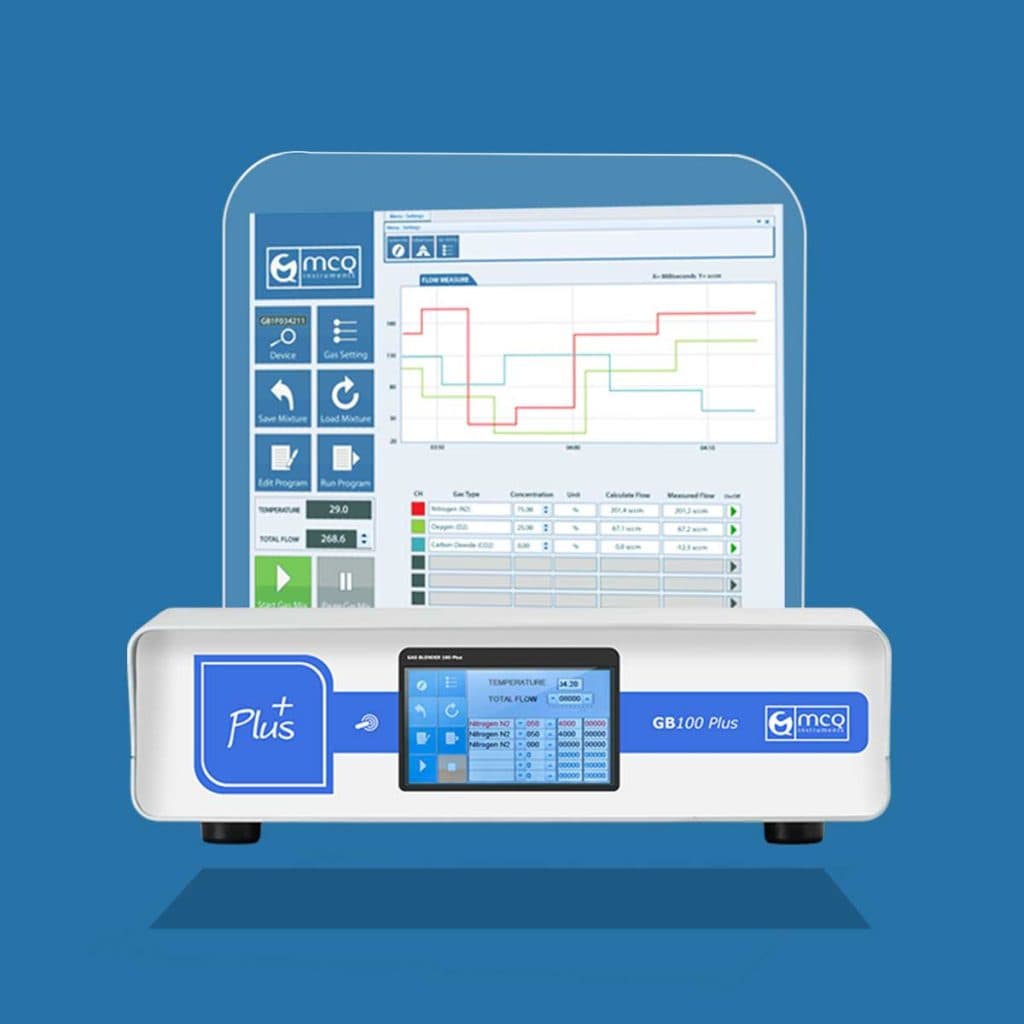
The Gas Blenders Series are the improved solutions proposed by MCQ. Designed following the Lab in Box concept, the MCQ Gas Blenders are high precision instruments, easy to configure, and adaptable to many different lab applications, they offer more efficiency and an innovative quick, and easy way for mixtures management, all in a compact case.
The Gas Blenders work with up to 6 components of gas mixtures, each gas media connected to a dedicated instrument channel for which MCQ guarantees high accuracy (1.0% of setpoint), high repeatability (0.16% of reading value), and the fastest response time for setpoint value change now available in the market.
The instruments work with dry gases and the channels are always calibrated with native gases following the customer's request. For gas mixture management, the MCQ Gas Mixture Creator Software is also provided.
Easy to use, and compatible with any common desktop or laptop PC (or touch screen for the latest products), the MCQ Software allows taking complete control over the gas mixer and its functions, letting the users start working with dynamic gas mixtures immediately with full automation.
Hardware Configuration
The gases typically used in this setup are:
- •Channel 1: Nitrogen (N₂)
- •Channel 2: Oxygen (O₂)
- •Channel 3: Carbon dioxide (CO₂)
The pure gas cylinders are connected to the instrument through 6 mm diameter tubing, and a check valve is installed on each line to prevent back-flow between channels.
Each gas is connected to and regulated by a dedicated channel of the MCQ Gas Mixer. The instrument blends the incoming gases to generate precise oxygen concentrations suitable for oxygen titration experiments. A final 6 mm outlet tube connects the mixer to the experimental system, such as a chamber, incubator, bioreactor, or sealed culture vessel where the biological samples are maintained.
The channels operate simultaneously to produce the desired gas mixture with controlled oxygen and carbon dioxide levels while maintaining nitrogen as a balancing gas. By adjusting the flow rates of the individual channels through the MCQ control software, researchers can precisely define the target oxygen concentration or program dynamic oxygen profiles during the experiment.
Institutions already using our Gas Mixers to ensure precise Oxygen levels in their cell culture
University of Oxford: Sir Prof. Peter J Ratcliffe Lab (Hypoxia, Nobel Prize for his studies on oxygen sensing)
Prange-Barczynska et al. Hif-2a programs oxygen chemosensitivity in chromaffin cells. The Journal of clinical investigation vol. 134,18 e174661. 6 Aug. 2024, doi:10.1172/JCI174661
California Institute of Technology: Hirotake Komatsu Lab (organoid culture):
Shang et al. A novel approach to determine the critical survival threshold of cellular oxygen within spheroids via integrating live/dead cell imaging with oxygen modeling. American journal of physiology. Cell physiology vol. 326,4 (2024): C1262-C1271. doi:10.1152/ajpcell.00024.2024
The University of Edinburgh: Prof. Dr. Karl Emanuel Busch Lab (hypoxia):
Li et al. High neural activity accelerates the decline of cognitive plasticity with age in Caenorhabditis elegans. eLife vol. 9 e59711. 24 Nov. 2020, doi:10.7554/eLife.59711
The University of Sydney: Dr. Cristina M Cook Lab (physioxia):
Martinez et al. A Cell Culture Model that Mimics Physiological Tissue Oxygenation Using Oxygen-permeable Membranes. Bio-protocol vol. 9,18 e3371. 20 Sep. 2019, doi:10.21769/BioProtoc.3371
Grenoble Alpes University: Prof. Diane Godin-Ribuot Lab (hypoxia):
Minoves et al. Chronic intermittent hypoxia, a hallmark of obstructive sleep apnea, promotes 4T1 breast cancer development through endothelin-1 receptors. Scientific reports vol. 12,1 12916. 28 Jul. 2022, doi:10.1038/s41598-022-15541-8
References
- •Arthur, P G et al. Protein synthesis during oxygen conformance and severe hypoxia in the mouse muscle cell line C2C12. Biochimica et biophysica acta vol. 1475,1 (2000): 83-9. doi:10.1016/s0304-4165(00)00046-5
- •Bourassa, Stéphane et al. Oxygen Conservation Methods With Automated Titration. Respiratory care vol. 65,10 (2020): 1433-1442. doi:10.4187/respcare.07240