Gas Mixer for H2 Gas Dilution and Sensor Calibration - Georgia University

SENSOR CALIBRATION
FAST RESPONSE
COMPACTNESS
TARGET OF THE PROJECT
H2 Gas Dilution and Sensor Calibration
Description of the Application.
Hydrogen (H2) gas has the potential to be a dominant future energy carrier, due to its high gravimetric energy density, sustainability, and lack of carbon emissions upon consumption. As hydrogen generation and hydrogen fuel cell technology continue to develop, the demand for hydrogen sensors for safely handling hydrogen gas in all stages of production, distribution, storage, and utilization will also continue to rise.
For hydrogen leakage detection and concentration controls, it is essential that hydrogen sensors have good stability, high sensitivity, good sensor accuracy, wide detection range, and fast response time.
For this application, we need to dilute the hydrogen gas in nitrogen to achieve several concentrations (from 100% hydrogen down to several hundred ppb of hydrogen in nitrogen). In addition, we would like to demonstrate that our sensor can achieve sub-second response time, in the detection range of 1000 mbar down to 1 mbar.
Therefore, the total response time of the gas blending system should be fast enough (ideally < 100 ms). For an ultra-low concentration of hydrogen, the flow rate and gas mixing process should be stable enough to achieve a reasonable signal-to-noise ratio.
Benefits and Savings.
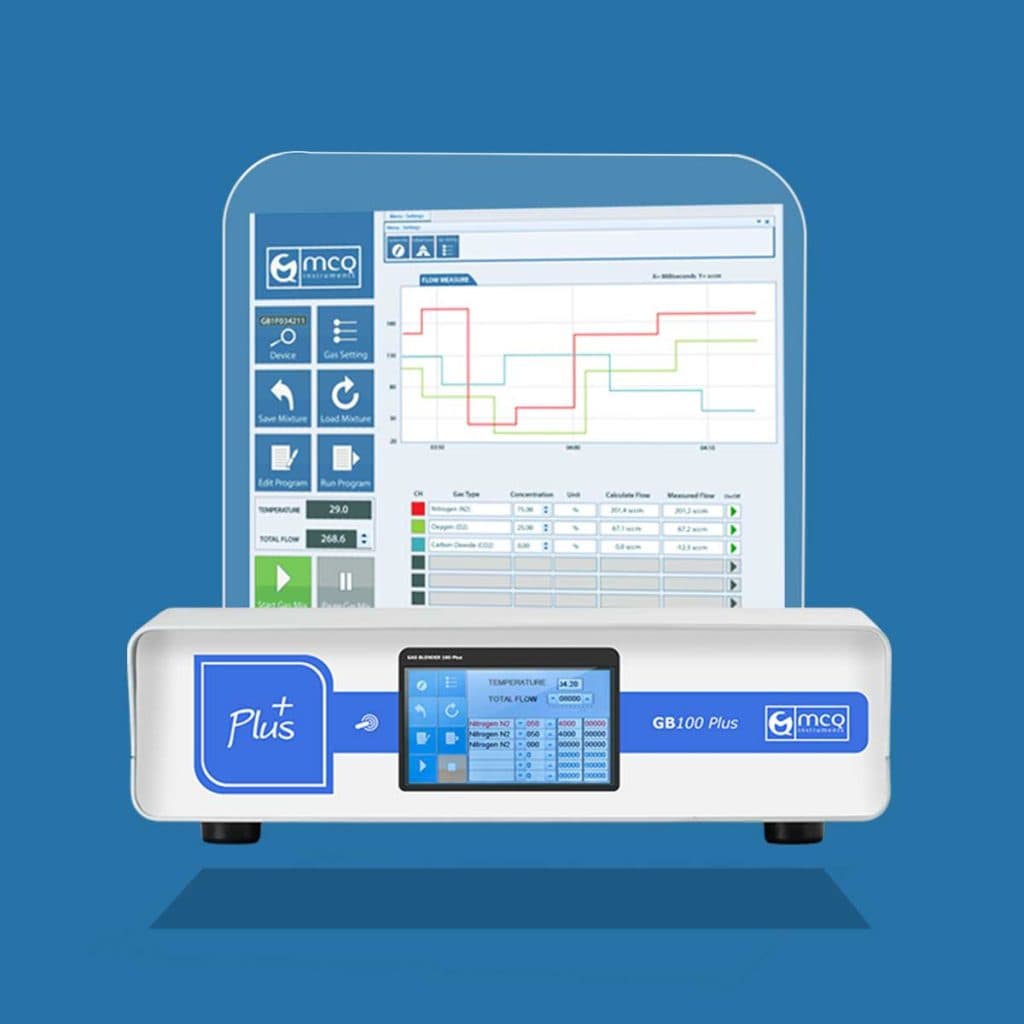
BENEFITS – A huge time-saving (for installation), money-saving (for all listed hardware above), space saving (a single box does not occupy much). Everything is compacted in a single box and you can control it easily with a USB-connected computer.
TIME SAVINGS – “The dilution process is very stable and we can achieve a stable sensor response in less than 1 minute. Without MCQ, we never achieve that signal-to-noise ratio.”
READ THE SCIENTIFIC PAPER.
Title: Bilayer plasmonic nano-lattices for tunable hydrogen sensing platform.ABOUT THE UNIVERSITY
The university is classified among “R1: Doctoral Universities – Very high research activity,” and as having “more selective” undergraduate admissions, the most selective admissions category, while the ACT Assessment Student Report places UGA admissions in the “Highly Selective” category, the highest classification. Among public universities, the University of Georgia is one of the nation’s top three producers of Rhodes Scholars over the past two decades.
Ref: WikipediaMAIN BENEFITS
- •COST AND SPACE SAVING. Thanks to a single box Univ. of Georgia can save money and space in its lab. Everything is compacted in a single box and you can control it easily with a USB-connected computer.
- •SUCCESSFUL ACHIEVEMENT. We helped the University of Georgia to get highly precise and stable micro flows of gas to calibrate sensors in a easy way thanks to our instrument and software.
- •TIME SAVING: 70%. Easier setup management of the hardware. Easier setup management of the software.
- •FAST RESPONSE: Thanks to a response in 50 ms to a change of Set-point, the dilution process is very stable and University of Georgia can achieve a stable sensor response in less than 1 minute.
- •MICRO FLOW. NO CUT-OFF. Our GB100 Series allows the Univ. of Georgia to control the flow in all the calibration range, from 0,1 ml/min to 500 ml/min with NO cut-off.
- •FLOW STABILITY. Thanks to our revolutionary method every gas flow has a great stability making possible to have a stable flow also for lower flow-range.