Gas Mixers for Chemiresistive Gas Sensor Materials Development
Characterising new sensing materials, from parts-per-billion detection limits to response and recovery times

Introduction
Behind every commercial gas sensor lies a material whose response to a target gas had to be discovered, measured and optimised. This is the upstream end of sensing technology: chemistry and materials science groups synthesise new conductive frameworks, two-dimensional crystals, metal oxides and functionalised films, then characterise how each one's electrical resistance changes when it meets the gas it is designed to detect.
Characterising a new material is a considerably more demanding measurement than calibrating a finished instrument. A commercial sensor has a known response that must be verified. A novel material has no known response at all, and everything about it must be established from first principles: how large the response is, how it scales with concentration, how low a concentration can still be resolved, how quickly the signal rises and falls, whether the baseline returns to where it started after each exposure, and whether all of this remains stable over repeated cycles.
Each of those questions places its own demand on the gas supply.
Establishing the concentration dependence requires a series of accurately known concentrations, typically spanning one to two orders of magnitude. The detection limit is then obtained by extrapolating the linear fit through those points, which means the accuracy of every individual concentration propagates directly into the headline sensitivity figure a paper reports.
Measuring response and recovery kinetics requires something different again: a rapid, clean switch between the analyte stream and a pure flush gas. Because the measured response time reflects both the material's intrinsic kinetics and the rate at which the test chamber atmosphere is actually exchanged, the volumetric flow rate through the chamber must be held constant and known. A small chamber flushed at a high, stable flow rate exchanges its atmosphere in seconds, which is what makes response times of a few tens of seconds meaningful rather than an artefact of slow gas delivery.
Assessing operational stability requires many identical exposure and recovery cycles, where any variation between cycles must be attributable to the material rather than to the gas supply.
And when two materials are being compared, as is almost always the case in a development programme, the entire scientific conclusion depends on both having been measured under demonstrably identical gas conditions.
Programmable gas mixing addresses all of these requirements from a single instrument. Certified source gases are diluted on demand to any concentration in the working range, the total flow through the test chamber is regulated independently of composition, and exposure and flush sequences are executed automatically and identically from one run to the next.
This approach provides several advantages:
- •Accurate generation of analyte concentrations across the full working range, from parts per billion to parts per million, from a small number of certified sources
- •Independent control of total flow rate through the test chamber, which governs atmosphere exchange time and therefore the validity of measured response kinetics
- •Rapid, repeatable switching between analyte and inert flush gas for response and recovery measurements
- •Stable baselines, since the flush gas is delivered at the same controlled flow as the analyte stream
- •Automated cycling for operational stability and reproducibility testing over many exposures
- •Identical, documented gas conditions across separate materials, which is what makes a comparative claim defensible
- •Multi-channel capability for cross-sensitivity and selectivity screening against interfering species
In conclusion, this approach makes our mixers a foundational tool for the research groups developing the sensing materials of the next generation of gas sensors, spanning two-dimensional conductive frameworks, metal-organic frameworks, metal oxides, functionalised graphene and electronic olfaction systems.
Gas Blenders & Gas Mixer Manager
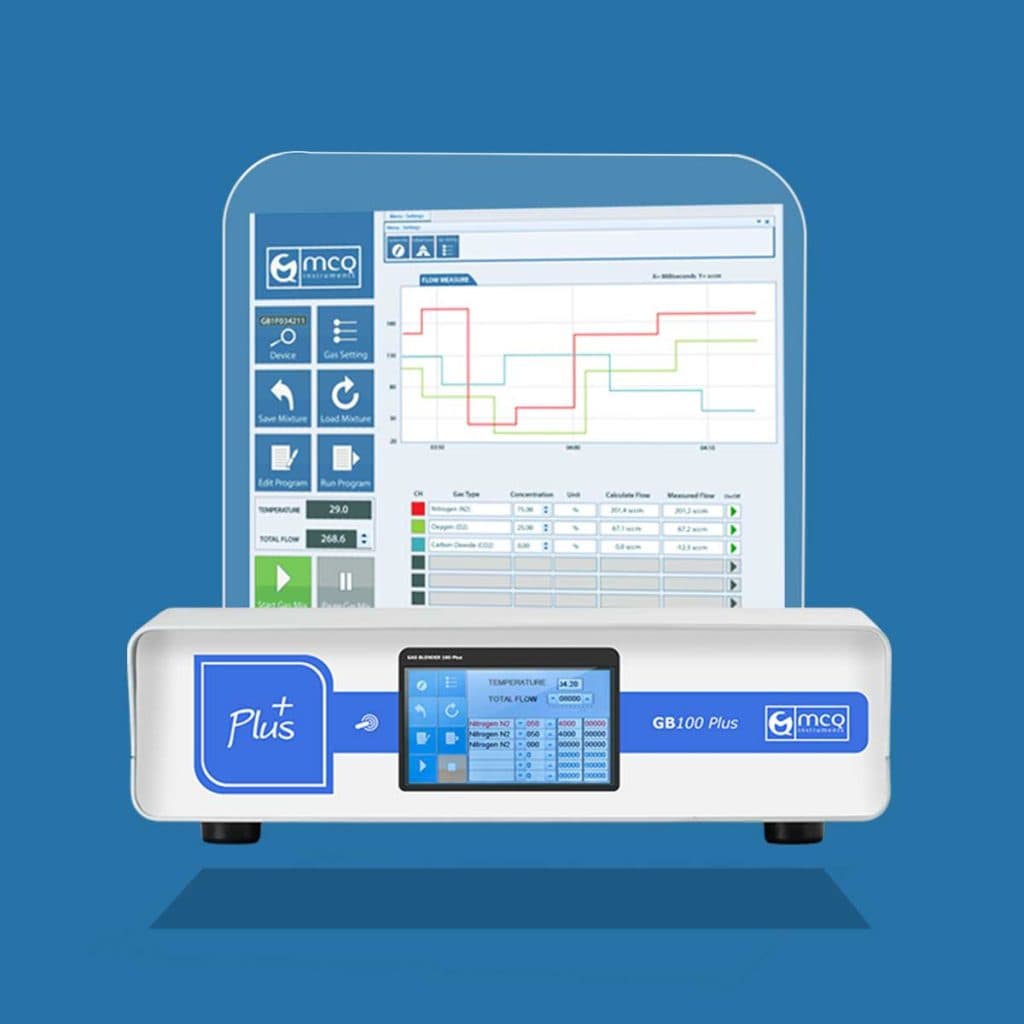
The Gas Blenders Series are the improved solutions proposed by MCQ. Designed following the Lab in Box concept, the MCQ Gas Blenders are high precision instruments, easy to configure, and adaptable to many different lab applications, they offer more efficiency and an innovative quick, and easy way for mixtures management, all in a compact case.
The Gas Blenders work with up to 6 components of gas mixtures, each gas media connected to a dedicated instrument channel for which MCQ guarantees high accuracy (1.0% of setpoint), high repeatability (0.16% of reading value), and the fastest response time for setpoint value change now available in the market.
The instruments work with dry gases and the channels are always calibrated with native gases following the customer's request. For gas mixture management, the MCQ Gas Mixture Creator Software is also provided.
Easy to use, and compatible with any common desktop or laptop PC (or touch screen for the latest products), the MCQ Software allows taking complete control over the gas mixer and its functions, letting the users start working with dynamic gas mixtures immediately with full automation.
Hardware Configuration
The gases typically used in this setup are:
- •Channel 1: Nitrogen (N₂) — carrier and diluent gas, and the flush gas used to recover the baseline between exposures
- •Channel 2: Target analyte, supplied as a certified pre-diluted mixture in nitrogen (for example ammonia, hydrogen sulphide, nitrogen dioxide or a volatile organic compound)
- •Channel 3 and beyond: Additional certified analytes, for selectivity and cross-sensitivity screening, or a second nitrogen line routed through a humidifier where the influence of humidity is being studied
The gas cylinders are connected to the instrument through 6 mm diameter tubing, and a check valve is installed on each line to prevent back-flow between channels.
Each gas is connected to and regulated by a dedicated channel of the MCQ Gas Mixer. The instrument dilutes the certified analyte stream with nitrogen to produce the required concentration and delivers it to a sealed test chamber in which the sensor device is mounted, typically a thin film deposited onto a pre-patterned electrode chip. The electrical response is recorded independently, with the device held at a constant bias voltage and its resistance monitored in real time by a source meter.
Because the mixer regulates the flow of every channel, it sets both the composition and the total volumetric flow rate delivered to the chamber. This second parameter deserves emphasis, because it is often overlooked. In published work of this kind, a sealed chamber of around 100 cm³ is flushed at a total flow of 500 standard cubic centimetres per minute, which corresponds to a complete exchange of the chamber atmosphere roughly every twelve seconds. Only when the atmosphere is exchanged this rapidly, and at a rate that does not vary, can a measured response time of a few tens of seconds be attributed to the material rather than to the delivery system.
By programming the MCQ control software, researchers can define a concentration series, execute repeated exposure and flush cycles of fixed duration, hold a stable baseline before measurement begins, and repeat the identical sequence on a second material for direct comparison.
Institutions already using our Gas Mixers for sensing materials research
Max Planck Institute of Microstructure Physics (Halle), Max Planck Institute for Polymer Research (Mainz), TUD Dresden University of Technology (CFAED), with University of Sofia, Helmholtz-Zentrum Dresden-Rossendorf (CASUS), Yonsei University and RWTH Aachen
Zhang, J., García-López, V., Wu, Y. et al. On-Water Surface Synthesis of 2D Conjugated Metal–Organic Framework Films With Controllable Layer Orientation Enabling High-Performance Chemiresistive Sensing. Advanced Materials vol. 38 e73785 (2026). doi:10.1002/adma.73785
This study demonstrates the on-water surface synthesis of conductive two-dimensional metal-organic framework films whose layer orientation can be programmed, producing either face-on or edge-on oriented Ni-HHTP films of approximately 70 nm thickness over centimetre-scale areas. The two orientations were then integrated into chemiresistive devices and compared directly.
As stated in the paper's experimental section, all sensing measurements were carried out in a sealed 100 cm³ chamber at room temperature, with the target gases supplied pre-diluted in dry nitrogen, and the desired analyte concentrations accurately controlled using a gas mixing and flow control system (MCQ Instruments, GB-103), with the total gas flow rate maintained at 500 sccm throughout. The measurement protocol comprised 60 seconds of gas exposure followed by 120 seconds of nitrogen flushing, preceded by a 10-minute nitrogen baseline.
Under these conditions the face-on oriented film delivered an ammonia response of 269.8% at 50 ppm with a response time of 23 seconds and a recovery time of 25 seconds at 20 ppm, and an ultralow limit of detection of 8.45 ppb at room temperature, derived from a linear concentration fit with a coefficient of determination of 0.998. The edge-on film, measured under identical gas conditions, reached a detection limit of 34.2 ppb with slower response and recovery and a progressively drifting baseline. The controlled comparison between the two orientations is what allows the performance difference to be attributed to the crystallographic orientation of the material itself.
The work was supported by ERC Synergy and ERC Consolidator grants and by the German Research Foundation, and is published open access.
References
- •Zhang, J et al. On-Water Surface Synthesis of 2D Conjugated Metal–Organic Framework Films With Controllable Layer Orientation Enabling High-Performance Chemiresistive Sensing. Advanced Materials vol. 38 e73785 (2026). doi:10.1002/adma.73785
- •Wang, W., Chen, L., Riemenschneider, L. et al. Highly Sensitive and Selective Zinc-Based Metal–Organic Framework Derivatives Gas Sensors for Trace H₂S Detection. ACS Sensors vol. 10 (2025): 7584-7598
- •Huang, S., Croy, A., Bierling, A.L. et al. Machine Learning-Enabled Graphene-Based Electronic Olfaction Sensors and Their Olfactory Performance Assessment. Applied Physics Reviews vol. 10 (2023): 021406
- •Meng, Z., Stolz, R.M., Mendecki, L., Mirica, K.A. Electrically-Transduced Chemical Sensors Based on Two-Dimensional Nanomaterials. Chemical Reviews vol. 119 (2019): 478-598
- •Campbell, M.G., Sheberla, D., Liu, S.F., Swager, T.M., Dincă, M. Cu₃(hexaiminotriphenylene)₂: An Electrically Conductive 2D Metal-Organic Framework for Chemiresistive Sensing. Angewandte Chemie International Edition vol. 54 (2015): 4349-4352