Gas Mixers for Automotive and Industrial Exhaust Emissions Sensor Testing
Reproducing exhaust gas compositions for the development of NOx, NH₃ and post-combustion sensors

Introduction
Emissions regulations for combustion engines and industrial plants have become progressively stricter, and the introduction of Euro 7 in Europe together with tightening EPA limits in the United States has placed renewed pressure on the sensing technologies that make compliance possible. Modern antipollution systems do not simply filter exhaust: they measure it continuously and adjust in real time. A selective catalytic reduction system, for example, injects a urea-derived reagent to convert nitrogen oxides into harmless nitrogen and water, and it must know at every moment how much NOx is present and whether unreacted ammonia is escaping downstream.
This creates a demanding requirement for the sensors themselves. An exhaust gas sensor must operate reliably in one of the harshest environments in engineering, at temperatures reaching several hundred degrees Celsius, in a chemically aggressive and constantly changing gas stream. It must distinguish between species that are chemically similar, since cross-sensitivity between nitrogen oxides and ammonia is a well-known and persistent challenge. And it must respond within seconds if it is to support real-time control.
Developing and validating such a sensor depends entirely on the ability to present it with exhaust-like gas mixtures of accurately known composition. The concentrations involved span a wide range: nitrogen oxides are typically measured at hundreds of parts per million, while ammonia slip must be detected at levels an order of magnitude lower. Researchers must characterise the sensor's response to each target gas individually, then quantify how the presence of the other exhaust components alters that response, and finally measure dynamic response times by switching concentrations rapidly.
Sourcing this range of mixtures as certified premixed cylinders is impractical and, with toxic and corrosive species such as nitrogen oxides, ammonia and sulphur compounds, it also means storing a large inventory of hazardous gas. Programmable gas mixing systems provide a far more workable alternative: a small number of certified source cylinders is diluted and blended on demand to produce any required composition.
This approach provides several advantages:
- •Generation of NO, NO₂, NH₃ and other exhaust species at precisely defined concentrations, from tens to thousands of parts per million
- •Reproduction of a realistic exhaust matrix, including nitrogen balance, oxygen content and other combustion products
- •Systematic study of cross-sensitivity by varying one species while holding all others constant
- •Rapid switching between compositions to measure sensor dynamic response and recovery times
- •Complete multi-point calibration curves generated automatically within a single experiment
- •A reduced inventory of hazardous premixed cylinders, since mixtures are produced from a limited set of certified sources
The gas mixer delivers the blended stream to the test apparatus, where the sensor under evaluation is held at its intended operating temperature. This separation is important: the mixture composition is defined with precision upstream, while the thermal conditions of the test chamber reproduce the harsh environment the sensor will ultimately face.
In conclusion, this approach makes our mixers a core enabling tool for emissions sensor research and development, supporting work on automotive antipollution systems, catalytic converter and aftertreatment technologies, industrial stack monitoring, and the optical and spectroscopic techniques increasingly used to measure post-combustion gases.
Gas Blenders & Gas Mixer Manager
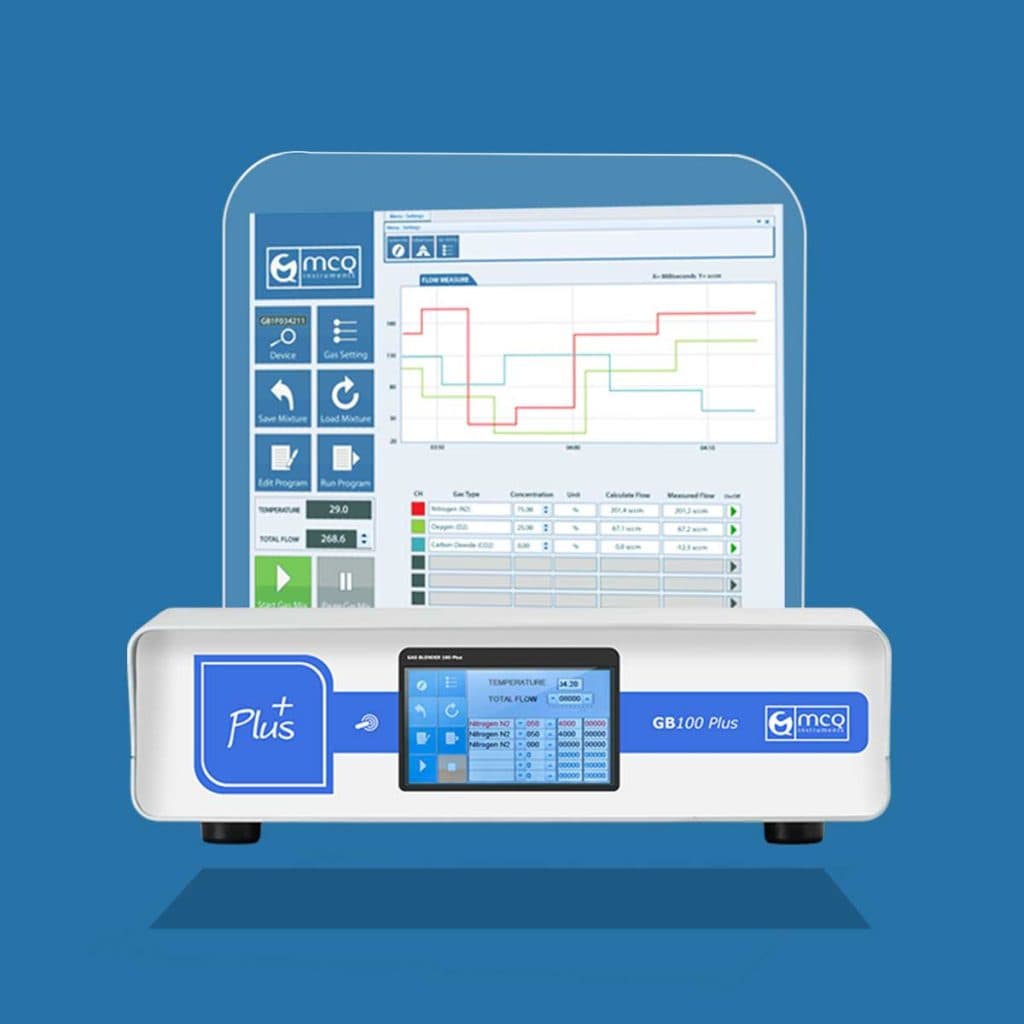
The Gas Blenders Series are the improved solutions proposed by MCQ. Designed following the Lab in Box concept, the MCQ Gas Blenders are high precision instruments, easy to configure, and adaptable to many different lab applications, they offer more efficiency and an innovative quick, and easy way for mixtures management, all in a compact case.
The Gas Blenders work with up to 6 components of gas mixtures, each gas media connected to a dedicated instrument channel for which MCQ guarantees high accuracy (1.0% of setpoint), high repeatability (0.16% of reading value), and the fastest response time for setpoint value change now available in the market.
The instruments work with dry gases and the channels are always calibrated with native gases following the customer's request. For gas mixture management, the MCQ Gas Mixture Creator Software is also provided.
Easy to use, and compatible with any common desktop or laptop PC (or touch screen for the latest products), the MCQ Software allows taking complete control over the gas mixer and its functions, letting the users start working with dynamic gas mixtures immediately with full automation.
Hardware Configuration
The gases typically used in this setup are:
- •Channel 1: Nitrogen (N₂) — balance and diluent gas
- •Channel 2: Nitric oxide (NO) — as a certified mixture in nitrogen
- •Channel 3: Nitrogen dioxide (NO₂) — as a certified mixture in nitrogen
- •Channel 4: Ammonia (NH₃) — as a certified mixture in nitrogen, for ammonia slip and SCR studies
- •Channel 5: Oxygen (O₂) or synthetic air — to reproduce lean and rich exhaust conditions
- •Channel 6: Carbon dioxide (CO₂) or a further certified species — to complete the combustion matrix
Because the Gas Blenders support up to six components, a single instrument can reproduce a realistic multi-species exhaust composition rather than a simplified binary mixture. This matters considerably when characterising cross-sensitivity, since a sensor's response to ammonia may differ substantially depending on the oxygen and nitrogen oxide levels surrounding it.
The gas cylinders are connected to the instrument through 6 mm diameter tubing, and a check valve is installed on each line to prevent back-flow between channels. Channel materials and seals are selected according to the reactive species involved.
Each gas is connected to and regulated by a dedicated channel of the MCQ Gas Mixer. The instrument blends the incoming gases to generate the target exhaust-like composition, and a final 6 mm outlet tube connects the mixer to the test apparatus, typically a heated test chamber, tube furnace or spectroscopic cell in which the sensor is held at its operating temperature.
The channels operate simultaneously to produce the desired mixture while maintaining nitrogen as the balancing gas. By adjusting the flow rates of the individual channels through the MCQ control software, researchers can define the concentration of each species independently, generate systematic dilution series, hold a fixed matrix while varying a single analyte, or program rapid step changes in composition to measure dynamic sensor response. Since the mixer regulates both composition and total flow, the gas exchange rate through the test chamber is equally well controlled, which is essential when response times of the order of a second are being measured.
Institutions already using our Gas Mixers for exhaust emissions sensor research
Georgia Tech Lorraine, Georgia Institute of Technology, PSA Peugeot Citroën, Université de Lille Sciences et Technologies and Université de Lorraine
Halfaya, Y., Bishop, C., Soltani, A., Sundaram, S., Aubry, V., Voss, P.L., Salvestrini, J.-P., Ougazzaden, A. Investigation of the Performance of HEMT-Based NO, NO₂ and NH₃ Exhaust Gas Sensors for Automotive Antipollution Systems. Sensors (Basel) vol. 16,3 273 (2016). doi:10.3390/s16030273
This study reports specially designed AlGaN/GaN high electron mobility transistors with a platinum-catalyst functionalised gate, developed for operation in the harsh environment of diesel exhaust systems. Sensor performance was found to be enhanced at 600 °C, with measured sensitivities of 24% to 900 ppm NO, 38.5% to 900 ppm NO₂ and 33% to 15 ppm NH₃, and dynamic response times as fast as one second for all three gases. The work is explicitly motivated by the need to meet forthcoming Euro 7 emission standards, and demonstrates the feasibility of controlling an antipollution system in real time.
CentraleSupélec and École Centrale de Pékin
Mengis, T., Genty, F., Aubert, T. Analysis of NO₂ absorption cross-sections at high temperature for the development of post-combustion gases optical sensor.
Nitrogen dioxide is a well-established pollutant affecting both human health and atmospheric chemistry, and current European standards impose very low NO₂ emission thresholds in exhaust gases. This work addresses the need for sensors able to monitor small NO₂ concentrations for real-time adjustment of engine performance. Absorption spectroscopy is identified as a method of particular interest, but such measurements depend on accurate knowledge of the NO₂ absorption cross-sections, which the study characterises at high temperature.
References
- •Halfaya, Y et al. Investigation of the Performance of HEMT-Based NO, NO₂ and NH₃ Exhaust Gas Sensors for Automotive Antipollution Systems. Sensors (Basel) vol. 16,3 273 (2016). doi:10.3390/s16030273
- •Mengis, T., Genty, F., Aubert, T. Analysis of NO₂ absorption cross-sections at high temperature for the development of post-combustion gases optical sensor.
- •Moos, R. A Brief Overview on Automotive Exhaust Gas Sensors Based on Electroceramics. International Journal of Applied Ceramic Technology vol. 2,5 (2005): 401-413. doi:10.1111/j.1744-7402.2005.02041.x
- •Ritter, T et al. Resistive Multi-Gas Sensor for Simultaneously Measuring the Oxygen Stoichiometry and the NOx Concentration in Exhausts. Sensors vol. 23,12 (2023). doi:10.3390/s23125645