Gas Mixers for Natural Gas and Hydrocarbon Trace Detection
From percent-level natural gas composition to parts-per-billion leak detection: precise hydrocarbon mixtures for sensor calibration
Introduction
The detection and quantification of light hydrocarbons, methane, ethane and propane, is a central requirement across the oil and gas industry, environmental monitoring, and industrial safety. The applications span an extraordinarily wide concentration range: characterising the composition of natural gas at percent level, monitoring production streams, identifying the origin of a gas reservoir from its hydrocarbon ratios, and detecting fugitive emissions or pipeline leaks at trace concentrations of parts per million or even parts per billion.
Modern optical sensing techniques, in particular quartz-enhanced photoacoustic spectroscopy (QEPAS) and light-induced thermo-elastic spectroscopy (LITES), have made this possible with compact, portable instruments capable of on-site analysis. However, every one of these sensors must be calibrated and validated against gas mixtures of accurately known composition before it can be trusted in the field.
This calibration requirement is considerably more demanding than it first appears. A sensor intended for natural gas analysis must be characterised across several orders of magnitude of concentration, from percent down to trace level. It must be calibrated for each target hydrocarbon individually and then validated on realistic multi-component mixtures, because natural gas is never a single compound. And critically, in photoacoustic and related techniques, the measured signal depends not only on the concentration of the target molecule but also on the composition of the surrounding gas matrix, which governs the molecular energy relaxation processes that generate the signal. Controlling the full mixture, not just the analyte, is therefore essential to obtaining a valid calibration.
Preparing this range of mixtures from certified premixed cylinders alone is impractical. Each concentration would require its own cylinder, multi-component blends at defined ratios would be prohibitively expensive to source, and any change to the experimental plan would mean procuring new gas.
Programmable gas mixing systems resolve this directly. By diluting certified source gases with a nitrogen matrix under precise flow control, a gas mixer can generate any target concentration on demand, define the exact ratio between multiple hydrocarbons, and step automatically through a full calibration sequence.
This approach provides several advantages:
- •Generation of any hydrocarbon concentration on demand, from natural gas percent levels down to trace ppb, without changing cylinders
- •Precise control of the methane, ethane and propane ratio to reproduce realistic natural gas compositions
- •Simultaneous regulation of both mixture composition and flow rate through the sensor gas line
- •Full control of the balance gas matrix, essential where sensor response depends on energy relaxation and matrix effects
- •Reproducible multi-point calibration curves generated automatically within a single experiment
- •Rapid switching between setpoints, enabling fast and repeatable characterisation of sensor linearity and detection limits
By importing a dynamic program into the instrument, developers can generate an entire dilution series, calibrate the sensor for each analyte separately, and then validate performance on synthetic natural-gas-like mixtures, all under stable and documented conditions.
In conclusion, this approach makes our mixers a foundational tool in the development, calibration, and validation of hydrocarbon gas sensors, supporting applications from upstream oil and gas exploration and production monitoring through to pipeline integrity, industrial safety, and environmental methane measurement.
Gas Blenders & Gas Mixer Manager
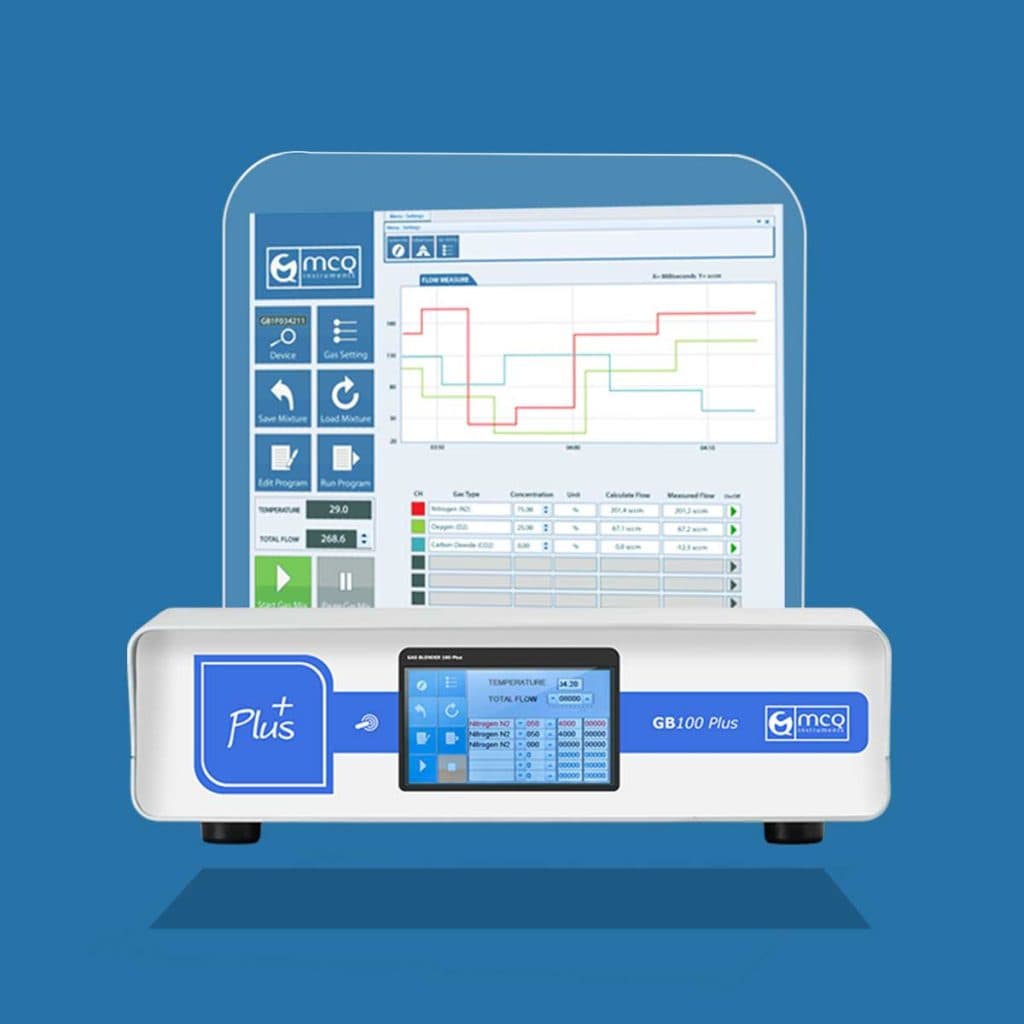
The Gas Blenders Series are the improved solutions proposed by MCQ. Designed following the Lab in Box concept, the MCQ Gas Blenders are high precision instruments, easy to configure, and adaptable to many different lab applications, they offer more efficiency and an innovative quick, and easy way for mixtures management, all in a compact case.
The Gas Blenders work with up to 6 components of gas mixtures, each gas media connected to a dedicated instrument channel for which MCQ guarantees high accuracy (1.0% of setpoint), high repeatability (0.16% of reading value), and the fastest response time for setpoint value change now available in the market.
The instruments work with dry gases and the channels are always calibrated with native gases following the customer's request. For gas mixture management, the MCQ Gas Mixture Creator Software is also provided.
Easy to use, and compatible with any common desktop or laptop PC (or touch screen for the latest products), the MCQ Software allows taking complete control over the gas mixer and its functions, letting the users start working with dynamic gas mixtures immediately with full automation.
Hardware Configuration
The gases typically used in this setup are:
- •Channel 1: Nitrogen (N₂) — carrier and balancing gas
- •Channel 2: Methane (CH₄, C1) — pure or as a certified mixture in nitrogen
- •Channel 3: Ethane (C₂H₆, C2) — as a certified mixture in nitrogen
- •Channel 4: Propane (C₃H₈, C3) — as a certified mixture in nitrogen, where required
Additional channels can be dedicated to further certified concentrations of the same analyte, allowing a single setup to span both the percent and the trace concentration ranges. In published sensor work, configurations using five certified cylinders — for example a high and a low concentration of methane in nitrogen, a high and a low concentration of ethane in nitrogen, and pure nitrogen, have been connected to a single gas blender to cover the full calibration range.
The gas cylinders are connected to the instrument through 6 mm diameter tubing, and a check valve is installed on each line to prevent back-flow between channels.
Each gas is connected to and regulated by a dedicated channel of the MCQ Gas Mixer. The instrument blends the incoming gases to generate precise hydrocarbon concentrations in a nitrogen matrix. A final 6 mm outlet tube connects the mixer to the sensor gas handling system, typically an acoustic detection module or spectroscopic cell, where the analysis is performed.
The channels operate simultaneously to produce the desired mixture while maintaining nitrogen as the balancing gas. Because the mixer regulates the flow of each component, it sets not only the composition but also the total flow rate delivered to the sensor, which is a critical parameter in continuous-flow spectroscopic measurements. Published sensor characterisation work has used the gas mixer to establish continuous flow regimes in the range of tens of standard cubic centimetres per minute, with the sensor operating pressure held constant by a dedicated pressure controller.
By adjusting the flow rates of the individual channels through the MCQ control software, researchers can precisely define the concentration of each hydrocarbon, generate systematic dilution series, and reproduce realistic natural gas compositions such as a 1:10 dilution in nitrogen.
IInstitutions already using our Gas Mixers for hydrocarbon detection research
PolySense Lab — Technical University of Bari and THORLABS GmbH (Prof. Vincenzo Spagnolo, Director)
Zifarelli et al. Methane and ethane detection from natural gas level down to trace concentrations using a compact mid-IR LITES sensor based on univariate calibration. Photoacoustics vol. 29 100448 (2023). doi:10.1016/j.pacs.2022.100448. In this work, a gas mixer (MCQ Instruments GB-100) was used to set both the methane–ethane–nitrogen mixing ratio in the samples and the flow rate within the gas line, with all measurements acquired in continuous flow regime at 50 sccm
Menduni et al. High-concentration methane and ethane QEPAS detection employing partial least squares regression to filter out energy relaxation dependence on gas matrix composition. Photoacoustics vol. 26 100349 (2022). doi:10.1016/j.pacs.2022.100349
PolySense Lab — Technical University of Bari, in collaboration with Rice University and Saudi Aramco
Luo, Harrist, Menduni, Mesdour, StMichel and Sampaolo. Simultaneous Detection of Methane, Ethane, and Propane by QEPAS Sensors for On-Site Hydrocarbon Characterization and Production Monitoring. ACS Omega (2022). doi:10.1021/acsomega.1c05645. A portable QEPAS gas analyser demonstrating ppb-level sensitivity for methane and ethane and ppm-level for propane, developed to introduce QEPAS technology to the oil industry.
Natural gas composition analysis with multi-component regression
Methane, Ethane, and Propane Detection Using a Quartz-Enhanced Photoacoustic Sensor for Natural Gas Composition Analysis. Energy & Fuels, ACS (2024). doi:10.1021/acs.energyfuels.4c03726. Natural-gas-like mixtures of the three alkanes diluted in a nitrogen matrix were generated by means of a gas mixer (MCQ Instruments GB-103), with the sensor calibrated for methane, ethane and propane separately before validation on multi-component blends.
Sequential multi-gas detection with beat-frequency QEPAS
Comparison of QEPAS and BF-QEPAS approaches for methane and ethane sequential detection in the near-IR spectral range. Optics and Laser Technology (2026). Five certified gas cylinders containing methane and ethane at two concentration levels each, plus pure nitrogen, were connected to a gas blender (MCQ Instruments, GB6000) to provide precise gas mixtures for sensor calibration.
Compact multi-hydrocarbon sensing with a single laser source
Sampaolo et al. Methane, ethane and propane detection using a compact quartz enhanced photoacoustic sensor and a single interband cascade laser. Sensors and Actuators B: Chemical vol. 282 (2019): 952-960. doi:10.1016/j.snb.2018.11.132
References
- •Zifarelli, A et al. Methane and ethane detection from natural gas level down to trace concentrations using a compact mid-IR LITES sensor based on univariate calibration. Photoacoustics vol. 29 100448 (2023). doi:10.1016/j.pacs.2022.100448
- •Menduni, G et al. High-concentration methane and ethane QEPAS detection employing partial least squares regression to filter out energy relaxation dependence on gas matrix composition. Photoacoustics vol. 26 100349 (2022). doi:10.1016/j.pacs.2022.100349
- •Luo, P et al. Simultaneous Detection of Methane, Ethane, and Propane by QEPAS Sensors for On-Site Hydrocarbon Characterization and Production Monitoring. ACS Omega (2022). doi:10.1021/acsomega.1c05645
- •Methane, Ethane, and Propane Detection Using a Quartz-Enhanced Photoacoustic Sensor for Natural Gas Composition Analysis. Energy & Fuels (2024). doi:10.1021/acs.energyfuels.4c03726
- •Sampaolo, A et al. Methane, ethane and propane detection using a compact quartz enhanced photoacoustic sensor and a single interband cascade laser. Sensors and Actuators B: Chemical vol. 282 (2019): 952-960. doi:10.1016/j.snb.2018.11.132
- •Olivieri, M et al. Characterization of H₂S QEPAS detection in methane-based gas leaks dispersed into environment. Photoacoustics vol. 29 100438 (2023). doi:10.1016/j.pacs.2023.100438