Gas Mixers for Hydrogen Sensor Development
Generating hydrogen concentrations from parts per billion to percent level, at the constant flow that sub-second response measurements depend on

Introduction
Hydrogen is colourless, odourless and flammable across an unusually wide range of concentrations in air. It cannot be smelled, it disperses quickly, and it diffuses through materials that contain other gases without difficulty. Every system that stores, moves or uses it therefore depends on instrumental detection, and as hydrogen infrastructure expands the sensors that watch over it are being asked to do more than confirm that a leak has become dangerous. They are being asked to find it while it is still small.
That shift changes what a hydrogen sensor has to achieve. Detecting a leak early means resolving concentrations far below any hazardous threshold, which pushes the required detection limit from the percent range down into parts per million and, for the most demanding applications, parts per billion. Detecting it quickly means responding in a fraction of a second rather than tens of seconds. Doing both at room temperature matters for two reasons: a heated sensing element consumes power continuously, and in an atmosphere that may become flammable, a hot surface is itself something to be avoided.
Palladium has been the material of choice for hydrogen sensing for a long time, because hydrogen dissolves into its lattice and changes its electrical resistance in proportion. The difficulty is that pure palladium undergoes a structural phase transition as it absorbs hydrogen, and that transition brings hysteresis, slow recovery and mechanical fatigue over repeated cycles. Much of the current research effort goes into suppressing it — alloying palladium with a second metal, confining it to nanoscale structures, or decorating it with other materials to alter how hydrogen reaches and leaves the active surface.
Testing whether any of this has worked places distinctive demands on the gas supply, and they differ from those of ordinary sensor characterisation.
The first is dynamic range. A hydrogen sensor intended for real use must be characterised from its detection limit up to concentrations approaching those of practical concern — a span that can reach five orders of magnitude. Generating that span from a small number of certified cylinders means diluting accurately and repeatably across the whole of it, since a detection limit quoted at the bottom of the range is only as trustworthy as the dilution that produced the lowest points.
The second is the flow rate, and in hydrogen work it carries unusual weight. A sensor that responds in a few tens of seconds can be measured with fairly relaxed gas delivery. A sensor that responds in a few tenths of a second cannot. The measured response time is always the convolution of the material's intrinsic kinetics with the time the test chamber takes to exchange its atmosphere, so a sub-second claim is only defensible if the chamber is flushed faster than the sensor reacts, at a flow rate that is both known and held constant. Below that threshold, the number being reported is the plumbing, not the material.
The third is recovery. Hysteresis is the specific failure mode under investigation in most palladium-based work, which means the return to baseline matters as much as the response to gas. That requires a clean, immediate switch to a pure flush stream delivered at the same regulated flow, repeated identically over many cycles so that any drift can be attributed to the sensor.
The fourth is humidity. Hydrogen sensors are deployed in real environments, and water vapour competes for the same adsorption sites. Establishing that a device survives high relative humidity requires the humidity to be a controlled variable rather than an ambient accident.
Programmable gas mixing addresses all four from a single instrument. Certified hydrogen sources are diluted on demand to any concentration in the working range, the total flow through the chamber is regulated independently of composition, and exposure and flush sequences run automatically and identically from one cycle to the next.
This approach provides several advantages:
- •Accurate dilution of certified hydrogen sources across several orders of magnitude, from percent-level mixtures down to parts per billion, from a small number of cylinders
- •Independent control of total flow rate, which sets the chamber exchange time and therefore determines whether a sub-second response time reflects the material or the delivery system
- •Rapid, repeatable switching between the hydrogen stream and an inert flush for response and recovery measurements
- •Stable baselines, because the flush gas arrives at the same controlled flow as the analyte stream
- •Automated cycling over many exposures, for the hysteresis and durability testing that palladium-based devices specifically require
- •A humidified channel where the influence of water vapour on sensor response is under investigation
- •Identical, documented gas conditions across separate device architectures, which is what makes a comparative claim defensible
In conclusion, this approach makes our mixers a practical instrument for the groups developing hydrogen sensing technology, from university physics and materials departments through to the national laboratories working on hydrogen infrastructure and safety.
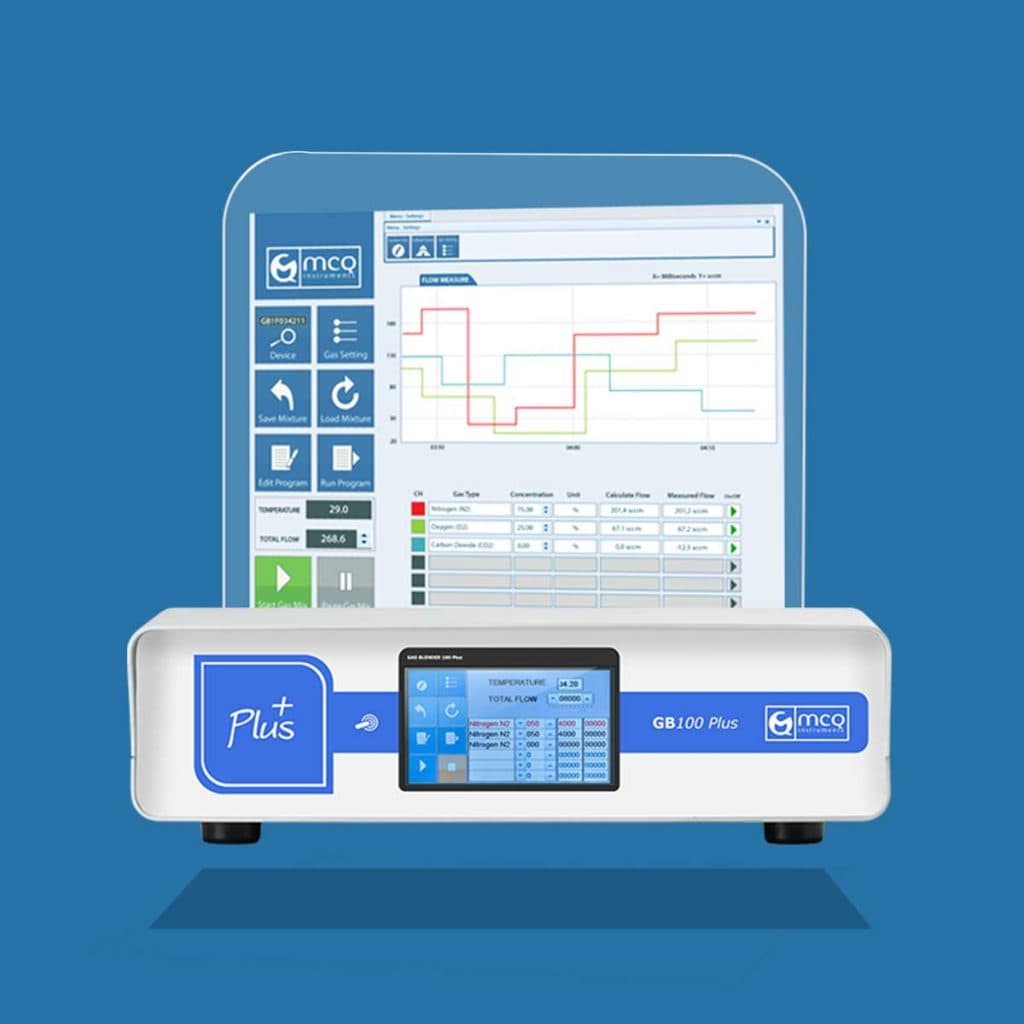
Gas Blenders & Gas Mixer Manager
The Gas Blenders Series are the improved solutions proposed by MCQ. Designed following the Lab in Box concept, the MCQ Gas Blenders are high precision instruments, easy to configure, and adaptable to many different lab applications, they offer more efficiency and an innovative quick, and easy way for mixtures management, all in a compact case.
The Gas Blenders work with up to 6 components of gas mixtures, each gas media connected to a dedicated instrument channel for which MCQ guarantees high accuracy (1.0% of setpoint), high repeatability (0.16% of reading value), and the fastest response time for setpoint value change now available in the market.
The instruments work with dry gases and the channels are always calibrated with native gases following the customer's request. For gas mixture management, the MCQ Gas Mixture Creator Software is also provided.
Easy to use, and compatible with any common desktop or laptop PC (or touch screen for the latest products), the MCQ Software allows taking complete control over the gas mixer and its functions, letting the users start working with dynamic gas mixtures immediately with full automation.
Hardware Configuration
The gases typically used in this setup are:
- •Channel 1: Ultra-high purity nitrogen (N₂) — diluent gas, and the flush gas used to recover the baseline between exposures
- •Channel 2: Hydrogen supplied as a certified mixture balanced in nitrogen. Published work of this kind draws on several source concentrations — for example 4% H₂ in N₂ for the upper decades and 100 ppm or 10 ppm H₂ in N₂ for trace-level measurements — so that no single dilution has to span the entire range
- •Channel 3 and beyond: a second nitrogen line routed through a humidifier where the influence of relative humidity is being studied, or an additional certified species for cross-sensitivity screening
The gas cylinders are connected to the instrument through 6 mm diameter tubing, and a check valve is installed on each line to prevent back-flow between channels.
Each gas is connected to and regulated by a dedicated channel of the MCQ Gas Mixer. The instrument dilutes the certified hydrogen stream with nitrogen to produce the required partial pressure and delivers it to the test chamber in which the sensor device is mounted. The electrical response is recorded independently, with the device held at a constant bias and its resistance monitored in real time.
Because the mixer regulates the flow of every channel, it sets both the composition and the total volumetric flow rate reaching the chamber. In hydrogen work this second parameter is not a secondary consideration. In the published study described below, the flow was held constant at 400 ml/min at 1 atm for every measurement in the series, and the device under test was reported to respond in 0.40 ± 0.06 seconds. A response time of that order can only be attributed to the sensing material if the surrounding atmosphere is replaced faster than the material reacts, and if the rate at which it is replaced does not vary between one measurement and the next.
By programming the MCQ control software, researchers can define a concentration series spanning several decades, execute repeated exposure and flush cycles of fixed duration for hysteresis testing, hold a stable baseline before measurement begins, and repeat the identical sequence on a second device architecture for direct comparison.
Institutions already using our Gas Mixers for hydrogen sensing research
University of Georgia, Savannah River National Laboratory, Utah State University, with Chulalongkorn University
Ngo, T.A., Magar, A.T., Pham, M.T. et al. Fullerene-decorated PdCo nano-resistor network hydrogen sensors with sub-second response and parts-per-billion detection at room temperature. Nature Communications (2025). doi:10.1038/s41467-025-67708-2
This study reports a hydrogen sensor built as a nano-resistor network from a palladium-cobalt alloy, decorated with fullerene and encapsulated in fluoropolymer layers. The alloy composition and the nanoscale architecture are intended to suppress the hydride phase transition that limits conventional palladium devices, and the fullerene layer modifies how hydrogen reaches the active surface.
As stated in the paper's methods, certified 4% H₂ in nitrogen mixtures were diluted with ultra-high purity nitrogen to the targeted concentrations using a commercial gas blender (GB-103, MCQ Instruments), with the gas flow rate held constant at 400 ml/min at 1 atm for all measurements. Lower-concentration certified sources of 100 ppm and 10 ppm H₂ in nitrogen were used to reach the trace end of the range.
Under these conditions the device delivered a response time of 0.40 ± 0.06 seconds across hydrogen partial pressures from 1 to 100 mbar, and a detection limit of approximately 40 parts per billion at room temperature, taken at a signal-to-noise ratio of 10. Measurements extended down to partial pressures of around 0.11 µbar in nitrogen, and the sensor was shown to continue operating in relative humidity up to 90%. The authors note that performance degraded rather than improved at elevated temperature, which is what makes the room-temperature result significant: no heater is required, and none is wanted in an atmosphere that may contain hydrogen.
The work was supported by the United States Department of Energy, Office of Energy Efficiency and Renewable Energy, through the Hydrogen and Fuel Cell Technologies Office under its Hydrogen Shot programme and a University Research Consortium on Grid Resilience, award DE-EE0010742. It is published open access.
References
- •Ngo, T.A., Magar, A.T., Pham, M.T. et al. Fullerene-decorated PdCo nano-resistor network hydrogen sensors with sub-second response and parts-per-billion detection at room temperature. Nature Communications (2025). doi:10.1038/s41467-025-67708-2
- •Zhang, J., García-López, V., Wu, Y. et al. On-Water Surface Synthesis of 2D Conjugated Metal–Organic Framework Films With Controllable Layer Orientation Enabling High-Performance Chemiresistive Sensing. Advanced Materials vol. 38 e73785 (2026). doi:10.1002/adma.73785
- •Luong, H.M., Pham, M.T., Guin, T. et al. Sub-second and ppm-level optical sensing of hydrogen using templated control of nano-hydride geometry and composition. Nature Communications vol. 12 (2021): 2414
- •Darmadi, I., Nugroho, F.A.A., Langhammer, C. High-Performance Nanostructured Palladium-Based Hydrogen Sensors — Current Limitations and Strategies for Their Mitigation. ACS Sensors vol. 5 (2020): 3306-3327
- •Hübert, T., Boon-Brett, L., Black, G., Banach, U. Hydrogen sensors — A review. Sensors and Actuators B: Chemical vol. 157 (2011): 329-352