Gas Mixers for Recyclable Electronic Materials Research
Proving that a regenerated material performs like the original — a claim that rests entirely on both having been measured under identical gas conditions

Introduction
Electronic devices are built from materials that are difficult to recover. Functional films are deposited in nanometre layers, bonded to substrates and encapsulated, and at end of life the economics of separating them rarely work. The result is that the scarce elements and synthetically expensive molecules inside them are generally lost.
A growing area of materials research sets out to change that at the design stage, by building materials that can be deliberately taken apart. The ambition is a closed loop: synthesise the material, use it in a working device, break it down on demand into its constituent parts, recover those parts at high purity, and build the next generation of material from them.
The chemistry is demanding, but it is not the hardest part of the argument to prove. The hard part is the claim that comes after it.
Recovering a molecule at high purity demonstrates that the recovery process works. It does not demonstrate that the material rebuilt from it is any good. For a closed loop to mean anything commercially, the regenerated material has to perform in a device as well as the original did — and that is not a chemistry measurement. It is a device measurement, and it is a comparative one.
This is where the experimental burden shifts onto the test conditions, and where it becomes unusually heavy.
When a single material is being characterised, a measurement error affects one number. When two materials are being compared, and the entire conclusion is that they are equivalent, any difference in the conditions under which they were measured becomes indistinguishable from a difference in the materials themselves. A regenerated sample that appears slightly worse may be genuinely worse, or it may simply have been tested at a marginally different analyte concentration, or at a different flow rate through the chamber, or against a baseline that had not fully stabilised. From the data alone, these are the same result.
Gas sensing is one of the most common ways to demonstrate that a regenerated electronic material still works, because a chemiresistive response is sensitive to almost everything about the film: its conductivity, its surface area, its crystallinity, its defect density. A sensor that performs identically after regeneration is strong evidence that the material has been genuinely reconstituted rather than approximately so.
That makes the gas supply part of the argument rather than part of the apparatus. The concentrations presented to the original device and to the regenerated one must be the same concentrations, produced the same way. The flow through the chamber must be the same flow. The exposure and recovery sequence must be the same sequence, run for the same durations. And all of it must be documented, because a reviewer assessing an equivalence claim will ask how the two measurements were held comparable.
Programmable gas mixing answers that directly. A concentration series is defined once and recalled identically weeks apart, the total flow is regulated independently of composition, and the full exposure and flush protocol executes automatically rather than by hand.
This approach provides several advantages:
- •Identical, repeatable analyte concentrations across measurements separated by the weeks that a degradation and regeneration cycle takes
- •Independent control of total flow rate, so that chamber exchange time is held constant between the original and the regenerated device
- •Automated exposure and flush sequences of fixed duration, removing operator variation from a comparison where operator variation would be indistinguishable from a materials effect
- •Stable, reproducible baselines before each measurement begins
- •Dilution of certified sources into air or into an inert carrier, according to the sensing chemistry under study
- •A documented, reproducible gas protocol — which is what an equivalence claim has to survive review
In conclusion, this approach makes our mixers a useful instrument for the groups working on circular-economy materials, where the commercial case depends not on recovering a material but on proving that the recovered material still does its job.
Gas Blenders & Gas Mixer Manager
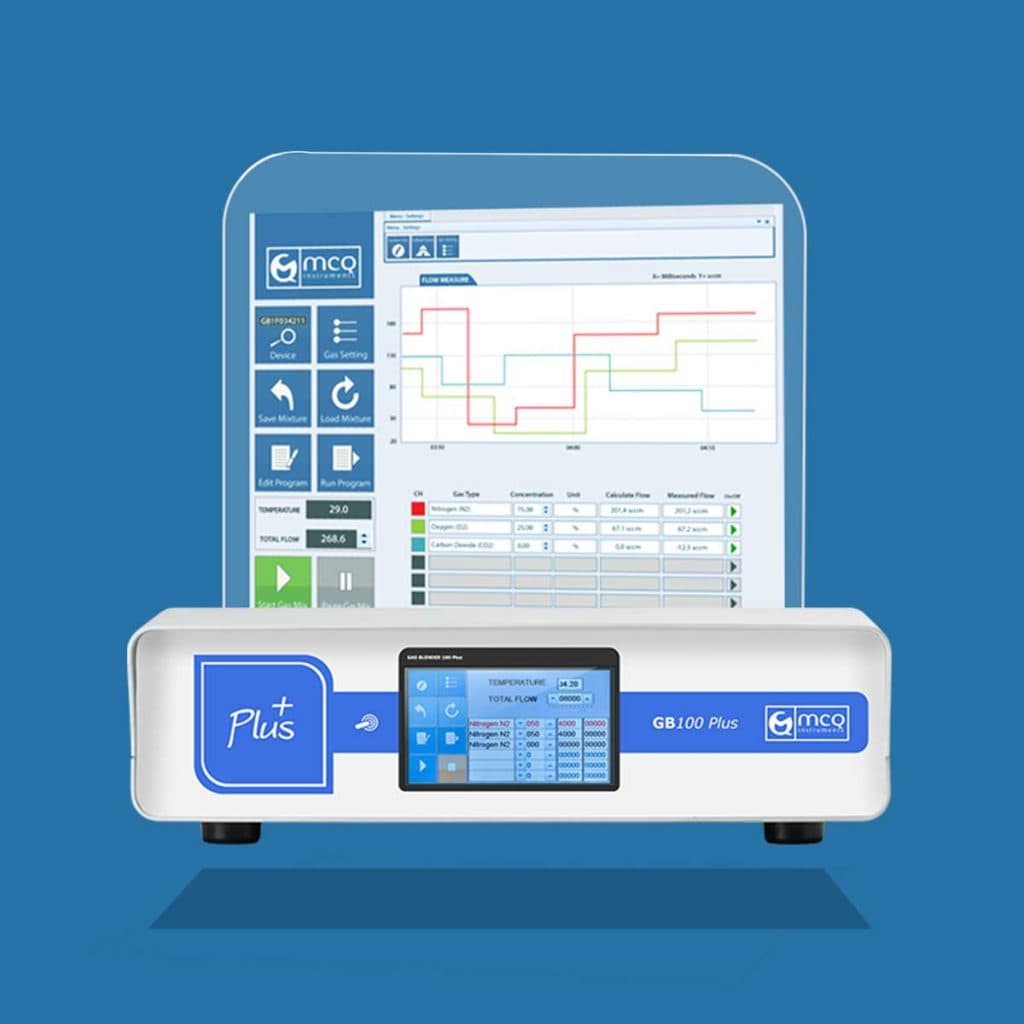
The Gas Blenders Series are the improved solutions proposed by MCQ. Designed following the Lab in Box concept, the MCQ Gas Blenders are high precision instruments, easy to configure, and adaptable to many different lab applications, they offer more efficiency and an innovative quick, and easy way for mixtures management, all in a compact case.
The Gas Blenders work with up to 6 components of gas mixtures, each gas media connected to a dedicated instrument channel for which MCQ guarantees high accuracy (1.0% of setpoint), high repeatability (0.16% of reading value), and the fastest response time for setpoint value change now available in the market.
The instruments work with dry gases and the channels are always calibrated with native gases following the customer's request. For gas mixture management, the MCQ Gas Mixture Creator Software is also provided.
Easy to use, and compatible with any common desktop or laptop PC (or touch screen for the latest products), the MCQ Software allows taking complete control over the gas mixer and its functions, letting the users start working with dynamic gas mixtures immediately with full automation.
Hardware Configuration
The gases typically used in this setup are:
- •Channel 1: Air, or an inert carrier such as nitrogen, serving both as the diluent and as the flush gas that returns the sensor to baseline between exposures. Which of the two is appropriate depends on the sensing chemistry — some materials require oxygen to be present for the sensing mechanism to operate at all, in which case the analyte is diluted into air rather than into nitrogen
- •Channel 2: The target analyte, supplied as a certified mixture
- •Channel 3 and beyond: additional certified analytes for selectivity screening, or a second carrier line routed through a humidifier where humidity is a controlled variable
The gas cylinders are connected to the instrument through 6 mm diameter tubing, and a check valve is installed on each line to prevent back-flow between channels.
Each gas is connected to and regulated by a dedicated channel of the MCQ Gas Mixer. The instrument sets the analyte-to-carrier ratio to produce the required concentration and delivers it to a sealed chamber containing the sensor device, typically a film deposited across pre-patterned electrodes. The electrical response is recorded independently: the device is held at a constant bias voltage and its resistance monitored in real time by a source meter.
The distinguishing feature of this application is not any single capability of the mixer but the repeatability of the whole protocol over time. A degradation and regeneration cycle takes weeks. The measurement made on the regenerated device must reproduce the one made on the original before it, long after the original run has finished and in many cases after the chamber has been opened, cleaned and reassembled. Because the MCQ control software stores concentration series and exposure sequences, the later run is a recall rather than a reconstruction — which is the difference between a comparison and an approximation.
Institutions already using our Gas Mixers for sustainable materials research
TUD Dresden University of Technology, Max Planck Institute of Microstructure Physics (Halle), with Max Planck and partner institutions in Germany and China
Guo, Q., Shi, S., You, N. et al. On-demand linkage cleavage in two-dimensional conjugated metal-organic frameworks for closed-loop recyclable electronics. Science Advances vol. 12, eaed9532 (2026). doi:10.1126/sciadv.aed9532
This study addresses the end-of-life problem for two-dimensional conjugated metal-organic frameworks, a class of material under active development for sensors, supercapacitors and printed electronics. The authors demonstrate that the metal-ligand coordination bonds holding the framework together can be cleaved deliberately: under alkaline conditions the metal centres are hydroxylated, and combined with ultrasonic cavitation the framework breaks down into its sodium-coordinated organic ligand and the corresponding metal hydroxides.
The reported degradation reaches up to 92.4% within 30 minutes, varying with the metal used — 92.3% for the zinc framework, 74.2% for copper, 63.5% for cobalt and 57.6% for nickel. The organic ligand is then recovered at purities and yields of 96.3% for zinc, 91.8% for copper, 88.6% for cobalt and 85.4% for nickel, with metal species recovered at 93.5%, and the recovered ligand is used to synthesise fresh framework material.
A life-cycle assessment modelled at industrial scale puts the regenerated route at 52 MJ/kg against 358 MJ/kg for direct synthesis, and at 4.8 kg CO₂-equivalent against 27.4 kg.
The functional proof is the part that depends on the gas supply. As stated in the paper's methods, the desired concentrations of analytes were precisely prepared by adjusting the analyte-to-air ratio using a gas mixing system (MCQ Instruments GB-103), with the sensor held at a constant bias voltage of 6 V and the electrical signal recorded by a source meter. Measured under these conditions, the copper framework sensors built from regenerated material retained the performance of those made from the original, as did the supercapacitor electrodes — which is the result that turns a recovery process into a closed loop.
References
- •Guo, Q., Shi, S., You, N. et al. On-demand linkage cleavage in two-dimensional conjugated metal-organic frameworks for closed-loop recyclable electronics. Science Advances vol. 12, eaed9532 (2026). doi:10.1126/sciadv.aed9532
- •Zhang, J., García-López, V., Wu, Y. et al. On-Water Surface Synthesis of 2D Conjugated Metal–Organic Framework Films With Controllable Layer Orientation Enabling High-Performance Chemiresistive Sensing. Advanced Materials vol. 38 e73785 (2026). doi:10.1002/adma.73785
- •Wang, W., Chen, L., Riemenschneider, L. et al. Highly Sensitive and Selective Zinc-Based Metal–Organic Framework Derivatives Gas Sensors for Trace H₂S Detection. ACS Sensors vol. 10 (2025): 7584-7598
- •Dong, R., Zhang, T., Feng, X. Interface-Assisted Synthesis of 2D Materials: Trend and Challenges. Chemical Reviews vol. 118 (2018): 6189-6235
- •Xu, G., Nicolas, W., Yuan, S. et al. Two-dimensional conjugated metal–organic frameworks (2D c-MOFs): chemistry and function for MOFtronics. Chemical Society Reviews vol. 50 (2021): 2764-2793. doi:10.1039/D0CS01160F