Gas Mixers for Methane Isotope Ratio Measurement
Generating isotopic reference standards on demand, by holding one channel constant while another is stepped

Introduction
Methane is the second most important greenhouse gas, and the question that matters is rarely how much of it there is. It is where it came from.
Microbial methane from wetlands, landfill and livestock carries a different carbon isotope signature from thermogenic methane released by oil and gas extraction, which differs again from the pyrogenic methane of combustion. The ratio of ¹³C to ¹²C in a sample — reported as δ¹³C, in parts per thousand against a reference standard — is the fingerprint that separates them. It is how an emission is attributed to a source, how a leak is traced to an operator, and how an inventory is checked against physical reality rather than against an estimate.
Conventionally this is measured by isotope-ratio mass spectrometry: accurate, expensive, laboratory-bound, and slow. A field-deployable optical sensor capable of the same discrimination would change where the measurement can be made, and that is what the work described below sets out to build.
The difficulty is one of proportion. Carbon-13 accounts for about 1.1% of natural carbon, so in a methane sample the ¹³CH₄ is roughly one part in ninety of the methane present. Useful source attribution needs that ratio resolved to a few parts per thousand — which means distinguishing changes in a minor isotopologue that are themselves a fraction of a percent of a quantity that is only one percent of the analyte.
This creates a gas-handling requirement unlike any other in sensor development, and it is worth stating precisely, because it is the opposite of what one might expect.
The sensor's measurement is self-correcting; the calibration is not. When both isotopologues are measured at the same instant in the same gas, as they are here through frequency multiplexing, drifts in pressure, temperature, laser power or total concentration affect both signals together and largely cancel in the ratio. That is the elegance of simultaneous detection. But it means the entire accuracy of the instrument rests on the calibration — on having presented it, beforehand, with samples whose isotope ratios were genuinely known.
So the gas mixer's job is to manufacture isotopic reference standards. And the requirement that follows is specific: the calibration demands samples in which the total methane concentration stays fixed while the ¹³C fraction varies. In the published work, total CH₄ was held at 1% while ¹³CH₄ was stepped across roughly 114 to 224 parts per million to produce five samples of differing isotopic ratio. If the ¹²CH₄ concentration drifts while the ¹³CH₄ is being added, the ratio presented to the sensor is not the ratio recorded, and every subsequent measurement inherits that error.
Holding one channel steady while stepping another is exactly what independent per-channel flow regulation provides, and it is not something a premixed cylinder can do at all. The commercial consequence is direct: instead of purchasing a set of certified isotope-ratio standards — each one a single fixed ratio, each one expensive — a laboratory buys two cylinders and generates any ratio it needs.
Pressure is a separate axis again. Photoacoustic detection of methane at these wavelengths runs far below atmospheric pressure; the measurement below was performed at 75 Torr. The mixture is defined at the mixer and the pressure is fixed downstream, so that composition and pressure never interfere with one another.
And humidity is a fixed ingredient. Water vapour promotes the vibrational relaxation that converts absorbed light into a pressure wave, so the samples were deliberately humidified — in this case by a Nafion humidifier placed after the mixer, holding H₂O constant across every measurement.
This approach provides several advantages:
- •Independent regulation of each channel, so that one component can be held constant while another is deliberately stepped — the requirement that isotope-ratio calibration rests on
- •Generation of a series of known isotopic ratios from two certified cylinders, in place of a shelf of single-ratio reference standards
- •Accurate dilution across the range from percent-level methane to parts per million of a minor isotopologue
- •Composition set at the mixer and pressure set downstream, for measurements made at a fraction of atmospheric pressure
- •Compatibility with humidification placed either as its own channel or downstream of the mixture
- •Repeatable, documented conditions across the hours of acquisition that an Allan–Werle stability analysis requires
- •The same configuration recalled identically when a second laser, resonator or spectral line is evaluated in the same rig
In conclusion, this approach makes our mixers a practical instrument wherever a measurement is a ratio rather than a quantity — from isotope spectroscopy and source attribution through to any calibration that depends on varying one component while the rest stay still.
Gas Blenders & Gas Mixer Manager
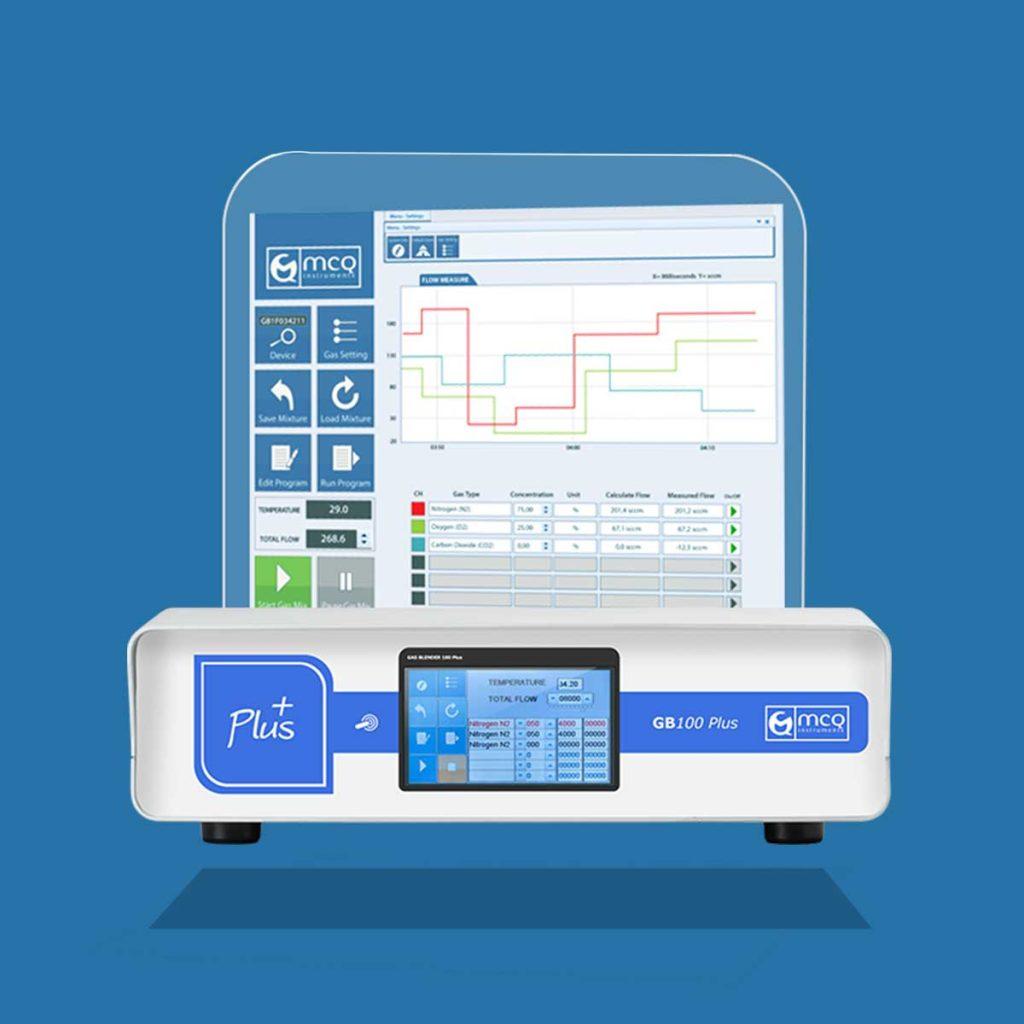
The Gas Blenders Series are the improved solutions proposed by MCQ. Designed following the Lab in Box concept, the MCQ Gas Blenders are high precision instruments, easy to configure, and adaptable to many different lab applications, they offer more efficiency and an innovative quick, and easy way for mixtures management, all in a compact case.
The Gas Blenders work with up to 6 components of gas mixtures, each gas media connected to a dedicated instrument channel for which MCQ guarantees high accuracy (1.0% of setpoint), high repeatability (0.16% of reading value), and the fastest response time for setpoint value change now available in the market.
The instruments work with dry gases and the channels are always calibrated with native gases following the customer's request. For gas mixture management, the MCQ Gas Mixture Creator Software is also provided.
Easy to use, and compatible with any common desktop or laptop PC (or touch screen for the latest products), the MCQ Software allows taking complete control over the gas mixer and its functions, letting the users start working with dynamic gas mixtures immediately with full automation.
Hardware Configuration
The gases used in this setup are:
- •Channel 1: Methane of natural isotopic abundance, as a certified mixture in nitrogen — in the published work, 10% CH₄ in N₂, comprising 9.89% ¹²CH₄ and 0.11% ¹³CH₄
- •Channel 2: Isotopically enriched ¹³CH₄, as a certified mixture in nitrogen, used to raise the ¹³C fraction of the sample in controlled increments
- •Channel 3: Pure nitrogen (N₂) as diluent, setting the total methane concentration independently of the isotopic composition
The gas cylinders are connected to the instrument through 6 mm diameter tubing, and a check valve is installed on each line to prevent back-flow between channels.
Each gas is connected to and regulated by a dedicated channel of the MCQ Gas Blender GB-100. The instrument meters the three flows independently to produce the required composition and delivers the mixture to the photoacoustic cell, where a quartz tuning fork sits in the path of two quantum cascade lasers. A pressure controller with a needle valve and pump, downstream of the cell, holds the gas at the operating pressure.
The three-channel arrangement is what makes the calibration possible. Channels 1 and 3 together fix how much methane is present; channel 2 changes what that methane is made of. Because the flows are regulated separately, total CH₄ can be held at 1% while ¹³CH₄ is stepped through a series of values — which is the one manipulation an isotope-ratio calibration requires and a premixed cylinder cannot perform.
Humidification can be introduced either as an additional channel carrying a humidified carrier, or, as in the work below, by placing a Nafion humidifier downstream of the mixer so that the water concentration is fixed for every sample regardless of the blend.
By programming the MCQ control software, researchers can define the isotopic series once and recall it identically, hold a composition stable across the hours an Allan–Werle analysis requires, and reproduce the same conditions when a second spectral line or resonator mode is assessed.
Institutions already using our Gas Mixers for isotope spectroscopy
PolySense Lab — University and Politecnico of Bari, with CNR IFN Bari and Shanxi University
Olivieri, M., Elefante, A., Menduni, G. et al. Simultaneous Detection of ¹²CH₄, ¹³CH₄, and Related Isotope Ratio Exploiting a Frequency-Multiplexed Mid-Infrared Quartz-Enhanced Photoacoustic Sensor. ACS Sensors (2025). doi:10.1021/acssensors.5c02871
This study reports a photoacoustic sensor that detects both methane isotopologues at the same moment, using two quantum cascade lasers — one at 7.82 µm targeting the ¹²CH₄ line at 1288.45 cm⁻¹, the other at 7.72 µm targeting ¹³CH₄ at 1296.03 cm⁻¹ — whose beams share a single quartz tuning fork. The two are told apart by frequency: each laser is modulated at half of a different mechanical resonance of the same fork, the fundamental mode at 2868.74 Hz and the first overtone at 17743.86 Hz, and the two signals are demodulated separately. One detector, one gas volume, two simultaneous measurements.
As stated in the paper, the gas handling system was composed of an MCQ Instrument Gas Blender GB-100, used to manage the flow rate for three gas channels and produce the desired gas mixture, together with a pressure controller, needle valve and pump used to fix the gas pressure and monitor the flow rate in the line. A Nafion humidifier was placed downstream of the gas mixer to humidify the samples, fixing the H₂O concentration for all measurements. Pure N₂ was employed as a diluent.
Calibration was carried out in two stages, using a certified 10% CH₄ in N₂ cylinder of natural isotopic abundance alongside a ¹³CH₄ cylinder, with ¹³CH₄ added sequentially to the mixture while the total CH₄ concentration was held fixed. From these, five methane samples of differing isotopic ratio were generated — total methane at 1% in wet nitrogen, with ¹³CH₄ varied across the series.
Measured at an operating pressure of 75 Torr, the sensor achieved a δ¹³C precision of 1 part per thousand at an integration time of 0.8 seconds for a 1% methane sample, with the ¹³CH₄ calibration returning a slope of 0.0872 mV/ppm. A two-hour Allan–Werle analysis was used to establish behaviour at longer integration times.
One per mil at sub-second integration, from a sensor built around a single tuning fork, is the result that makes the approach interesting: it brings isotope-ratio discrimination within reach of an instrument that can be carried to the emission rather than requiring the sample be carried to the laboratory.
The work is published open access under a CC-BY 4.0 licence.
References
- •Olivieri, M., Elefante, A., Menduni, G. et al. Simultaneous Detection of ¹²CH₄, ¹³CH₄, and Related Isotope Ratio Exploiting a Frequency-Multiplexed Mid-Infrared Quartz-Enhanced Photoacoustic Sensor. ACS Sensors (2025). doi:10.1021/acssensors.5c02871
- •Kinjalk, K., Paciolla, F., Sun, B. et al. Highly selective and sensitive detection of volatile organic compounds using long wavelength InAs-based quantum cascade lasers through quartz-enhanced photoacoustic spectroscopy. Applied Physics Reviews vol. 11, no. 2 (2024). doi:10.1063/5.0189501
- •Zifarelli, A., Giglio, M., Menduni, G. et al. Methane and ethane detection from natural gas level down to trace concentrations using a compact mid-IR LITES sensor based on univariate calibration. Photoacoustics vol. 29 (2023): 100448
- •Patimisco, P., Sampaolo, A., Dong, L., Tittel, F.K., Spagnolo, V. Recent advances in quartz enhanced photoacoustic sensing. Applied Physics Reviews vol. 5 (2018): 011106
- •Menduni, G., Zifarelli, A., Sampaolo, A. et al. High-concentration methane and ethane QEPAS detection employing partial least squares regression to filter out energy relaxation dependence on gas matrix composition. Photoacoustics vol. 26 (2022): 100349