Gas Mixers for Photoacoustic VOC Detection
Delivering benzene, toluene and propane from parts per billion to parts per million, at the sub-atmospheric pressure each molecule requires
Introduction
Volatile organic compounds are measured because of what low concentrations of them do to people. Benzene is a confirmed human carcinogen and long-term exposure is linked to leukaemia; toluene, ethylbenzene and xylene carry their own health burden. Occupational and environmental limits for this family sit in the parts-per-billion to low parts-per-million range, which means a sensor intended for workplace or ambient air has to resolve concentrations four to six orders of magnitude below a percent.
Sensitivity alone is not the difficulty. Hydrocarbons are spectroscopically crowded: methane, ethane, propane and the aromatics share absorption regions, and water vapour and carbon dioxide absorb across much of the useful infrared. A sensor that detects benzene at parts per billion in clean nitrogen may be unable to find it in a real gas stream rich in light hydrocarbons. Selectivity, not sensitivity, is usually what decides whether an instrument leaves the laboratory.
Photoacoustic spectroscopy approaches the problem from an unusual direction. Rather than measuring how much light survives a path through the gas, it measures the sound the gas makes when it absorbs. A modulated laser beam is absorbed by the target molecule, the absorbed energy becomes heat, the heat becomes a pressure wave, and a sharply resonant quartz tuning fork converts that wave into an electrical signal. There is no optical detector in the beam path, the fork responds only at its own resonance, and the signal is proportional to concentration and to laser power.
That mechanism places demands on the gas supply which differ from those of any other sensing technique, and they are worth setting out because they are not obvious.
The first is pressure, and it is not a constant. Photoacoustic signal strength depends on gas pressure through two competing effects: the quality factor of the tuning fork rises as pressure falls, while the efficiency of converting absorbed light into heat falls with it. The optimum is a compromise, and it is different for every molecule. In the published work described below the optimal pressures were 200 Torr for toluene, 500 Torr for benzene and 400 Torr for propane — all well below atmospheric, and separated by a factor of two and a half. The gas delivery system therefore has to produce a defined composition and let that composition be held at a chosen, variable, sub-atmospheric pressure. Composition and pressure are independent axes, and conflating them destroys the measurement.
The second is water vapour, and here the usual logic inverts. In most gas-sensing work humidity is an interferent to be removed or, at best, a variable to be controlled. In photoacoustics it is a reagent. The conversion of absorbed light into heat depends on how quickly a vibrationally excited molecule transfers that energy into translational motion, and water vapour is among the most effective promoters of that relaxation. Too dry a sample relaxes too slowly, the pressure wave arrives out of phase with the modulation, and the signal collapses. This is why the calibrations below were performed by diluting the certified mixture with humidified nitrogen rather than dry nitrogen. Humidity is part of the recipe.
The third is dynamic range. Characterising a sensor from its detection limit up to concentrations of practical interest spans five orders of magnitude — from single parts per billion to hundreds of parts per million. Producing that range from a small number of certified cylinders means diluting accurately and repeatably across the whole of it, since a detection limit quoted at the bottom is only as good as the dilution that produced the lowest points.
The fourth is selectivity testing, which requires making the problem worse on purpose. Establishing that a sensor can find benzene in a hydrocarbon-rich stream means deliberately blending that stream: target analyte against controlled backgrounds of methane and ethane, at known ratios, so that any spectral interference can be measured rather than assumed.
Programmable multi-channel gas mixing answers all four. Each channel's flow is regulated independently, so the composition is set at the mixer while pressure is set downstream; a humidified carrier can be introduced as its own channel; concentration series spanning several decades are defined once and recalled identically; and interferent backgrounds are blended to specification rather than approximated.
This approach provides several advantages:
- •Independent regulation of each gas channel, so that mixture composition is controlled separately from the cell pressure the measurement requires
- •Accurate dilution of certified mixtures across several orders of magnitude, from hundreds of parts per million down to single parts per billion
- •A humidified carrier stream delivered as a controlled component rather than an ambient accident
- •Reproducible concentration series for calibration curves, where the quoted sensitivity is the slope of a fit and therefore only as trustworthy as the points beneath it
- •Deliberate blending of interferent backgrounds for selectivity testing against realistic gas matrices
- •Stable, repeatable conditions across the long noise acquisitions that Allan–Werle analysis of a detection limit depends on
- •Identical gas conditions when comparing one laser, resonator or spectral region against another
In conclusion, this approach makes our mixers a practical instrument for laser spectroscopy groups developing trace-gas sensors, from fundamental photoacoustic research through to the instruments built for occupational exposure and environmental monitoring.
Gas Blenders & Gas Mixer Manager
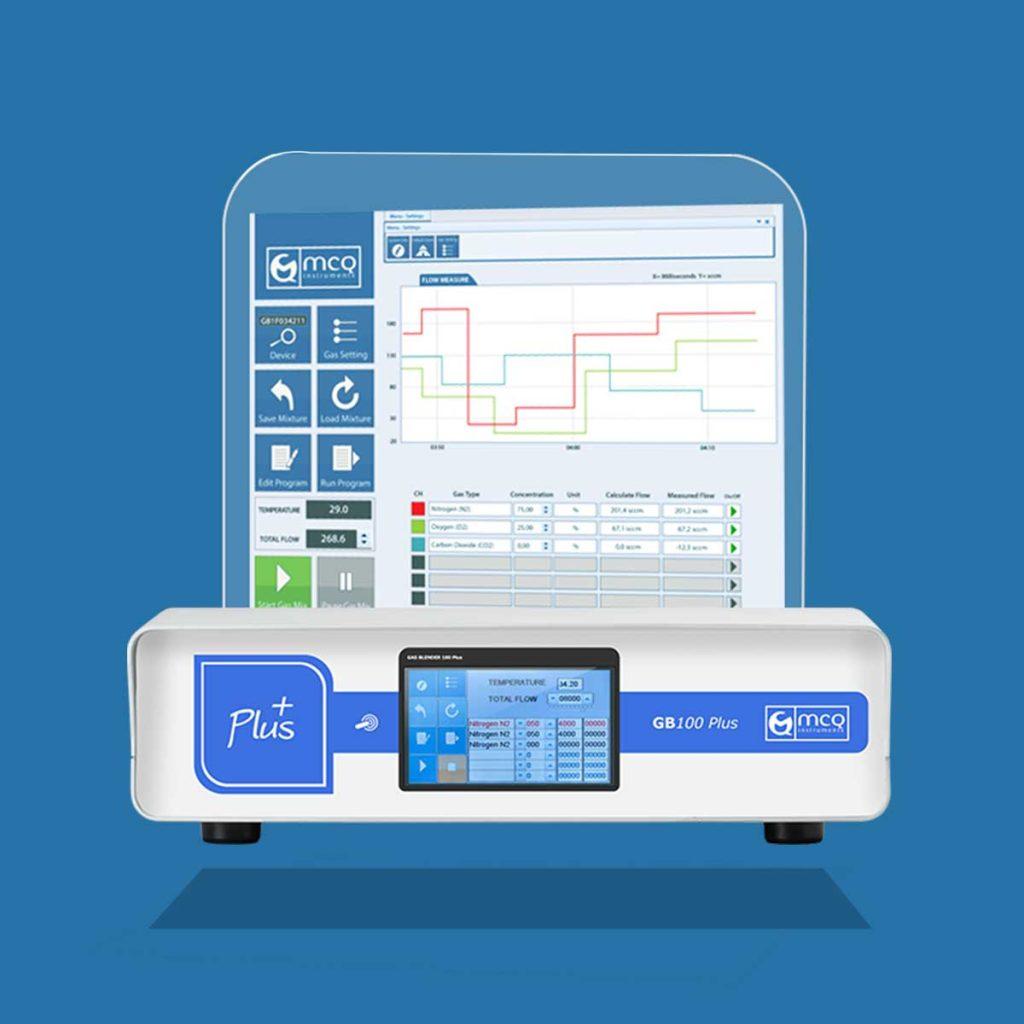
The Gas Blenders Series are the improved solutions proposed by MCQ. Designed following the Lab in Box concept, the MCQ Gas Blenders are high precision instruments, easy to configure, and adaptable to many different lab applications, they offer more efficiency and an innovative quick, and easy way for mixtures management, all in a compact case.
The Gas Blenders work with up to 6 components of gas mixtures, each gas media connected to a dedicated instrument channel for which MCQ guarantees high accuracy (1.0% of setpoint), high repeatability (0.16% of reading value), and the fastest response time for setpoint value change now available in the market.
The instruments work with dry gases and the channels are always calibrated with native gases following the customer's request. For gas mixture management, the MCQ Gas Mixture Creator Software is also provided.
Easy to use, and compatible with any common desktop or laptop PC (or touch screen for the latest products), the MCQ Software allows taking complete control over the gas mixer and its functions, letting the users start working with dynamic gas mixtures immediately with full automation.
Hardware Configuration
The gases typically used in this setup are:
- •Channel 1: Nitrogen (N₂) — carrier and diluent gas, in high purity
- •Channel 2: The certified target mixture, supplied as a known concentration of the analyte balanced in nitrogen
- •Channel 3: A second nitrogen line routed through a bubbler or humidifier, where the relative humidity of the sample is a controlled parameter
- •Channel 4 and beyond: certified interferent species — methane, ethane or other light hydrocarbons — for selectivity testing against realistic matrices
The gas cylinders are connected to the instrument through 6 mm diameter tubing, and a check valve is installed on each line to prevent back-flow between channels.
Each gas is connected to and regulated by a dedicated channel of the MCQ Gas Mixer. The instrument meters the flow of every channel independently to produce the required composition and delivers it to the photoacoustic cell, where the quartz tuning fork and its acoustic micro-resonators sit in the laser beam path. A pressure controller and needle valve downstream of the cell, working against a vacuum pump, hold the cell at the pressure chosen for the analyte under study.
The division of labour matters. The mixer sets what the gas is; the downstream controller sets the pressure it is held at. Because the two are regulated separately, the same certified mixture can be measured at 200 Torr for one molecule and 500 Torr for another without the composition changing between the two measurements — which is what makes a comparison between molecules, or between resonator designs, meaningful.
By programming the MCQ control software, researchers can define a calibration series spanning several decades of concentration, hold a composition stable for the hours a noise acquisition requires, introduce a humidified carrier at a set fraction, and reproduce the identical sequence when a second laser or resonator is placed in the same rig.
Institutions already using our Gas Mixers for laser spectroscopy research
Politecnico di Bari (PolySense Lab), with partner institutions in France and China
Kinjalk, K., Paciolla, F., Sun, B. et al. Highly selective and sensitive detection of volatile organic compounds using long wavelength InAs-based quantum cascade lasers through quartz-enhanced photoacoustic spectroscopy. Applied Physics Reviews vol. 11, no. 2 (2024). doi:10.1063/5.0189501
This study reports a quartz-enhanced photoacoustic sensor operating in the 12.1–15.4 µm range, a spectral region reached using InAs-based long-wavelength quantum cascade lasers, and applied to the detection of toluene, benzene and propane. The long wavelengths are significant because they access fundamental molecular absorption bands, where absorption is far stronger than in the overtone regions reachable with shorter-wavelength sources.
As stated in the paper, the components of the gas line include certified gas cylinders, a gas blender, a pressure regulator, a needle valve and a vacuum pump; with pure N₂ as the carrier gas, the gas blender (MCQ Instruments) is used to precisely control the flow rate of each individual gas channel and produce the desired gas mixture. Calibration was performed by acquiring spectral scans at different target concentrations obtained by diluting the certified mixture with humidified nitrogen.
The custom T-shaped quartz tuning fork used in the work resonates at 1 245 727 Hz with a quality factor of 9296 at atmospheric pressure in nitrogen. Optimal operating pressures were determined separately for each analyte — 200 Torr for toluene, 500 Torr for benzene and 400 Torr for propane — with sensitivities of 0.12, 8.9 and 0.003 mV/ppm respectively.
Under these conditions the sensor reached minimum detection limits of 113 parts per billion for toluene, 3 parts per billion for benzene and 3 parts per million for propane at an integration time of 10 seconds, even in complex gas matrices. An Allan–Werle deviation analysis across a 2.5-hour noise acquisition gave detection limits of 375 ppb, 13 ppb and 15 ppm at an integration time of 0.1 seconds, confirming that sensitivity improves with integration until long-term laser and thermal drifts take over.
The 3 ppb figure for benzene is the one that matters commercially: it sits below the occupational exposure limits applied to a recognised carcinogen, which is the threshold a monitoring instrument has to cross to be useful rather than merely sensitive.
The work is published open access under a Creative Commons licence.
References
- •Kinjalk, K., Paciolla, F., Sun, B. et al. Highly selective and sensitive detection of volatile organic compounds using long wavelength InAs-based quantum cascade lasers through quartz-enhanced photoacoustic spectroscopy. Applied Physics Reviews vol. 11, no. 2 (2024). doi:10.1063/5.0189501
- •Zifarelli, A., Giglio, M., Menduni, G. et al. Methane and ethane detection from natural gas level down to trace concentrations using a compact mid-IR LITES sensor based on univariate calibration. Photoacoustics vol. 29 (2023): 100448
- •Patimisco, P., Sampaolo, A., Dong, L., Tittel, F.K., Spagnolo, V. Recent advances in quartz enhanced photoacoustic sensing. Applied Physics Reviews vol. 5 (2018): 011106
- •Menduni, G., Zifarelli, A., Sampaolo, A. et al. High-concentration methane and ethane QEPAS detection employing partial least squares regression to filter out energy relaxation dependence on gas matrix composition. Photoacoustics vol. 26 (2022): 100349
- •Kosterev, A.A., Bakhirkin, Y.A., Curl, R.F., Tittel, F.K. Quartz-enhanced photoacoustic spectroscopy. Optics Letters vol. 27 (2002): 1902-1904